THE PYRAMIDS of the COLD • Chapter 57 How the ancient Egyptians glorified Science itself with the magnifying glass and with the Eye of Horus looking through that glass
Publié par Bruno Coursol dans The Pyramids of the Cold le 21/09/2025 à 06:29

The Egyptian way of representing the eye looking through a magnifying glass. "The astronomical ceiling at the Pronaos, outer hypostyle hall in the Temple of Hathor in the Dendera Temple complex, near Dendera, Egypt: first Band west from the centre, showing the full healed moon on a pillar depicted as "Wadjet" the Eye of Horus healed by [the god of Science] Thoth, who is portrayed at the right." Photograph thanks to kairoinfo4u: https://www.flickr.com/photos/manna4u/9295311496
THE PYRAMIDS of the COLD • Study written by Bruno COURSOL (January 2021 to September 2025)
Section J • The obsession of the ancient Egyptians for Science and Technology
What egyptologists have really missed is the real cement, but also the obsession that the ancient Egyptians had with knowledge in general, science and technology in particular: their entire civilization was entirely focused on these disciplines. In many ways, they had absolutely nothing to envy of the development that the West achieved around the beginning of the 19th century AD.
Chapter 57 • How the ancient Egyptians glorified Science with the magnifying glass

In summary: as we have seen many times throughout this study of The Pyramids of the Cold, the original tragedy facing the discipline that seeks to understand ancient Egyptian civilization is that egyptologists are not scientists per se, but rather belong to what might be described as the humanities. Often, however, many scientists are called upon by egyptologists, but the roles are clearly defined: the invited scientists are seen only as consultants, and those who call the shots, those who lead, are the egyptologists.
The second black spot afflicting the discipline of Egyptology today is simply the fact that for more than 200 years, since its inception, egyptologists have never changed their narrative: what was true in the early 1800s is still what is told today; and obviously, no truly scientific discipline can make the same observation. By definition, science progresses, science evolves, and new paradigms regularly come to the fore, only to be replaced by new ones in an eternal cycle of advancing knowledge.
Egyptologists, for their part, are light years away from this approach: according to them, what was true 200 years ago is still true today, and perhaps even after The Pyramids of the Cold, the same pretty little stories from the 19th century will continue to be told. The future of The Pyramids of the Cold depends on only one thing: the choice, not of egyptologists, but of the general public, to finally see the ancient Egyptians for who they really were and not for what we love to imagine them as. The ancient Egyptians were the first great scientists in the history of humanity, and in this chapter we will examine their representation of the greatest symbol of science: the magnifying glass.
[Biconvex lens at the Lombardy Cultural Heritage] “This lens is a transparent body bounded by two convex spherical surfaces. The tiltable lens has a brass rim and is fixed, via a fork, to a wooden stand. It has a focal length of 40 cm. Function : Through the phenomenon of refraction, the lens bends the light rays passing through it, causing them to converge. The characteristics of the images formed of a given object depend on the distance of the object from the lens.” https://www.lombardiabeniculturali.it/scienza-tecnologia/schede/8e020-00063/

On the right of the image is represented god of Science and Knowledge Thoth, facing the very symbol of Science: the magnifying glass. "The astronomical ceiling at the Pronaos, outer hypostyle hall in the Temple of Hathor in the Dendera Temple complex, near Dendera, Egypt: first Band west from the centre, showing the full healed moon on a pillar depicted as "Wadjet" the Eye of Horus healed by [the god of Science] Thoth, who is portrayed at the right." Photograph thanks to kairoinfo4u: https://www.flickr.com/photos/manna4u/9295311496
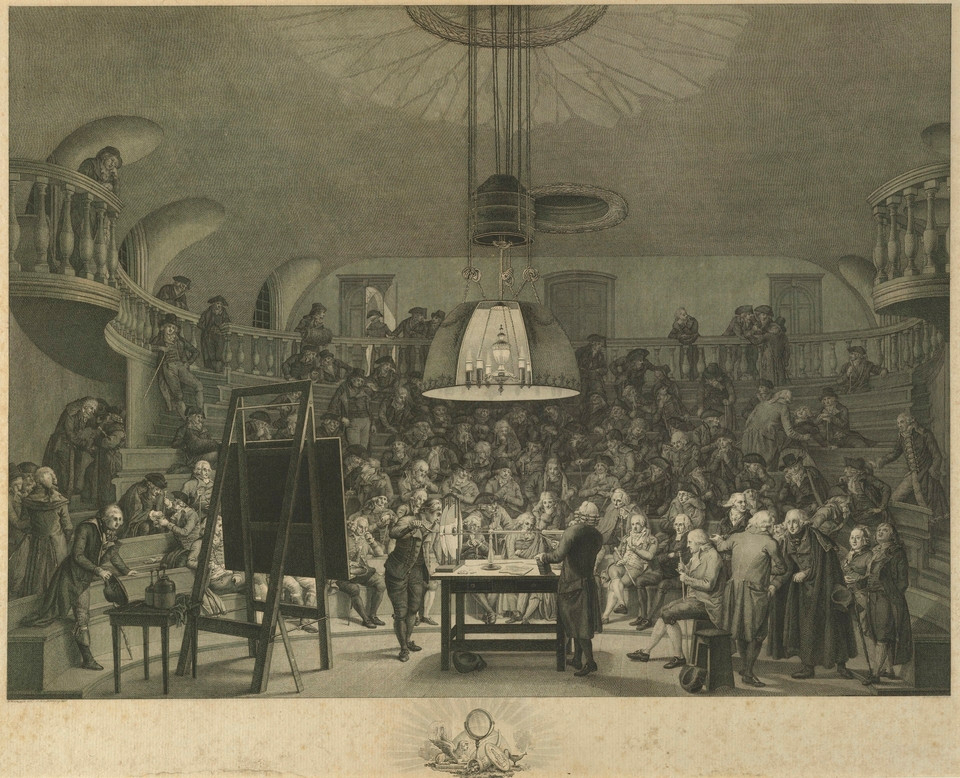
"This engraving shows Dutch mathematician and physicist Jean Henri van Swinden (1746–1823) demonstrating the generation of electricity to the Felix Meritis Society in Amsterdam. The Felix Meritis Society was founded in the late 18th century to promote the arts and sciences (Felix Meritis translates as "Happiness through Merit")". Barbiers, Pieter Pietersz., and Jacques Kuyper. Laid paper, 1800–1899. Science History Institute, Philadelphia U.S.A.: https://digital.sciencehistory.org/works/zg64tm573

57.01 What god of Science and Knowledge Thoth is worshiping is the very symbol of science: the magnifying glass
There is truly something powerful and moving about comparing the two above images: this illustration of a scientific demonstration from the 1800s devoted to the production of electricity, and the illustration of Thoth in the temple of Dendera, depicted facing the first symbol of science, the magnifying glass. In a way, these two illustrations are not only similar, they are almost identical: Thoth demonstrates his scientific knowledge through the magnifying glass, and to all the other gods gathered before him, just as the Dutch mathematician and physicist Jean Henri van Swinden demonstrated the generation of electricity at the Felix Meritis Society in Amsterdam. Of course, the Egyptologists' version is quite different, since it tells us of the full moon placed on a crescent moon, itself placed on a pedestal, the idea having been to represent a ‘healed moon.’ What's truly beautiful about all these desperate yet adorable attempts by egyptologists to construct a ‘coherent’ narrative is how ultimately the general public seems to embrace all these outlandish ideas: why on earth would the ancient Egyptians have thought of depicting the full moon resting on a crescent moon, which, by the way, isn't even depicted in a credible position? And why would they have the need to depict this ‘double moon’ resting on a pillar?
I believe the general public actually enjoys all these inconsistencies, and in a way feeds off them: the more nonsense egyptologists tell us, the more it reinforces the idea that the ancient Egyptians will forever remain a mystery. What The Pyramids of the Cold shows is that the ancient Egyptians were actually identical in every way to what we are today, that there really is no real mystery, and that everything can be reconstructed if one is truly willing to take the trouble. The question is therefore ultimately very simple: will the general public finally really want to know and understand ancient Egypt, or will they, on the contrary, prefer to continue being told pretty little stories?

The ancient Egyptian god of science and knowledge Thoth (on the right part of the image), looking through a magnifying glass... or for some esoteric reason: "looking at the full moon, on top of a crescent moon, itself on top of a pillar". Be sure that there is only one right answer here; but there is an extra clue, and that is the Eye of Horus.

57.02 Because a magnifying glass is meant for an eye, Egyptians represented the Eye of Horus on that magnifying glass
What's truly disturbing, and certainly depressing at the same time, is the fact that no one disputes the fact that Thoth is the god of science and knowledge, everyone agrees on that, but because egyptologists have been so successful in imbuing the public with their own narrative, almost religiously passed down from generation to generation, it is like no one sees that in his famous depiction in the temple of Dendera, he is simply facing what has always been the universal and timeless symbol of science: the magnifying glass.
Even if today the magnifying glass is part of what we are quite right to call low-tech, given how technological progress has succeeded in providing scientists with magnifying tools of astonishing performance, the magnifying glass still remains the ultimate symbol of science. Well, once again, what is true today was already true 4,500 years ago for the ancient Egyptians. Their entire civilization was about science and knowledge, and they’ve used and glorified the magnifying glass. Knowing that Thoth is, in short, the god of science, one might wonder why no one has ever suggested that he simply stood in front of a magnifying glass with a magnificent gilded wooden stand, which would have looked remarkably like a 19th-century antique magnifying glass with tiltable lens.
But one might also wonder why no one has ever suggested that the depiction of the Eye of Horus is precisely because a magnifying glass is intended to be viewed with only one eye.
Jim Hutton as detective Ellery Queen, looking through a magnifying glass, courtesy of NBC Television: https://en.wikipedia.org/wiki/Magnifying_glass#/media/File:Jim_Hutton_Ellery_Queen_1976.JPG

Operating diagram of the Great Pyramid of Khufu for flash-evaporative cold production, hypothetically for cooling down a Solvay-like process and the manufacturing of chemically manufacturing of 100% pure natron, the salt used by Egyptians for the mummification process.



© 2021-2025 Copyright milleetunetasses.com. All rights reserved.
