THE PYRAMIDS of the COLD • Chapter 45 Why are Goliath and the Star of David the reinterpretations of the hauling Beetle
Publié par Bruno Coursol dans The Pyramids of the Cold le 21/09/2025 à 06:32

This is how ancient Egyptians represented the idea of men operating a hauling gantry from the inside ot the wooden structure, like the one used in the Great Pyramid of Khufu. Below, is the Jewish reinterpretation of that gantry operated by six crewmembers: the hexagonal Star of David, also known as the Shield of David, because the hauling gantry looked like both a beetle scarab and a protective shield.
THE PYRAMIDS of the COLD • Study written by Bruno COURSOL (January 2021 to September 2025)
Section G • The hauling process in the Grand Gallery of the Great Pyramid of Khufu
For the impactor to be brought back up to the top of the Gallery, a hauling team of six crewmembers was in operation inside the hauling Beetle and the ropes were operated through a windlass and four redirecting Egyptian pulleys
Chapter 45 • Why are Goliath and the Star of David the reinterpretations of the hauling Beetle

In summary: inside the Grand Gallery of the Great Pyramid, were seven teammates who collectively operated all the equipment that allowed to haul back the impactor all the way up, to the top of the central wooden Djed caisson, in a secured position, ready to be released into the steep slope of the Gallery. The hauling Beetle was a wooden gantry structure, made of two halves, one on each ramp of the Gallery and it was operated by two teams of three men. Additionally to these six crewmembers who were most of the time inside the hauling gantry; was the leader of the team for a total of seven teammates.
At the end of this chapter, we'll see that just like for everything else, these seven teammates had been glorified by ancient Egyptians in one of the most important ancient Egyptian myth: the myth of Isis and the Seven Scorpions; but just like everything they've done, Egyptians were really 'hard on metaphors', there is not much to get from the Seven Scorpions. Hopefully, what is gonna be the most important source of information about the hauling Beetle's operation and its crew in this chapter, doesn't come from Egypt, but from the Jewish religion. And that is certainly one of the most groundbreaking revelations of this study: the ancient Egyptian religion didn't really disappeared; it didn't really vanished, it simply evolved into a new religion, with new gods, prophets and myths. Probably the Jewish religion is nothing but another interpretation, another glorification of what happened in the Great Pyramid of Khufu.
We've already seen a few Jewish reinterpretations of the ancient Egyptian glorifications, but for now, we're gonna talk about the myth of David and Goliath, and you'll see that many informations that Egyptians didn't give by themselves, are clearly revealed in the Jewish religion. At the end of the pharaonic era, when pharaohs' power declined, so did their religion; and it is in this context that the Jewish religion emerged. We'll see that myth about David and Goliath is nothing but the reinterpretation of the hauling Beetle's operation, and finally we'll see that the Star of David itself really is the glorification of the hauling Beetle's operation, and why the Star can also be called a Shield.
[above illustration] The Star of David featured in the oldest complete copy of the Masoretic text, the Leningrad Codex, dated 1008: https://en.wikipedia.org/wiki/Star_of_David#/media/File:Leningrad_Codex_Folio_474a.jpg

Willing to solve the exact meaning and birth of the three main religions of today seems completely pretentious, and I completely agree on that; but it really looks like when Egyptian pharaohs seem to have built an entire religion crafted under their control, to legitimate themselves as the rulers of Egypt, one of the most compelling notion that comes with the Jewish religion, is that there in no more control over the people. In other words, the ancient Egyptian religion has been created by and for the ruling class as a simple tool towards their people, when the Jewish religion has only been made for the people themselves, to help them in their everyday life and to assemble them into a strong community, independently from their rulers.
In short: Hebrews could be seen as real heretics, and it probably has something to do with the eternal persecution that Israel is constantly facing in the region. I would say it is only logical, that the Jewish religion was born by some ancient Egyptian heretic priests, who would have seen the change coming with the decline of the pharaoh's political influence, and who would have used their knowledge on how was operated the Great Pyramid, to create a new religion, fully designed for the people themselves, but with the same fantastic layer of extraordinary meanings.
It also looks like the Jewish religion was only interested in how was operated the impactor of the Great Pyramid, and the crucial role of everything that was set inside the Grand Gallery. We'll see now that the so-called Goliath (or should I say the two Goliaths), is nothing but a reinterpretation of the hauling Beetle, and that David is only about the one crewmember who had to get inside the Djed caisson to reconnect the impactor with the hauling ropes.
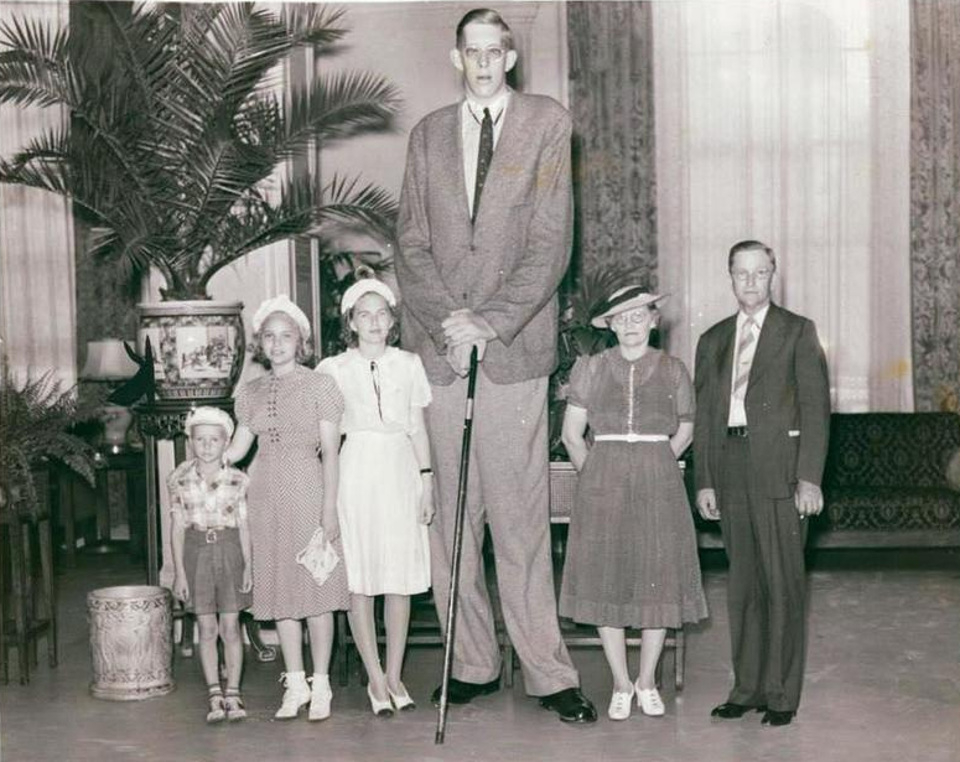
Robert Wadlow is the tallest person in documented history. Due to an overactive pituitary gland, he was taller than his father at age 8 and continued to grow reaching 8 feet 11 inches (2.72 metres) for 230 kg at age 22. Pictured with his family at age 21, Robert Wadlow died at age 22 (height of Goliath: 2.97 metres).
45.01 The incredible description of Goliath at about 3 meters high, though ferocious and as strong as an ox!
Many people, including scholars, doubt that the David and Goliath story is real, and not just because of the size of the giant, which would have made Goliath taller than the famous "tallest human ever" Robert Wadlow. Robert Wadlow gained his formidable height because of an abnormally high level of human growth; he had a very poor health and died at the age 22 because of it. By comparison, Goliath's height would have been 2.97 meters (about 30 cm more than Robert Wadlow), and he would have been strong as an ox.
"Robert Pershing Wadlow (February 22, 1918 – July 15, 1940), also known as the Alton Giant and the Giant of Illinois, was an American man who was the tallest person in recorded history for whom there is irrefutable evidence. He was born and raised in Alton, Illinois, a small city near St. Louis, Missouri. Wadlow's height was 8 ft 11.1 in (2.72 m) while his weight reached 439 lb (199 kg) at his death at age 22. His great size and his continued growth in adulthood were due to hypertrophy of his pituitary gland, which results in an abnormally high level of human growth hormone (HGH)."
"The oldest manuscripts, namely the Dead Sea Scrolls text of Samuel from the late 1st century BCE, the 1st-century CE historian Josephus, and the major Septuagint manuscripts, all give Goliath's height as "four cubits and a span" (6 feet 9 inches or 2.06 metres), whereas the Masoretic Text has "six cubits and a span" (9 feet 9 inches or 2.97 metres). Many scholars have suggested that the smaller number grew in the course of transmission (only a few have suggested the reverse, that an original larger number was reduced), possibly when a scribe's eye was drawn to the number six in line 17:7." https://en.wikipedia.org/wiki/Goliath
45.02 The scholar attempts to diminish Goliath's height
Because of his exaggerate gigantic height which actually discredit the whole story just by itself, scholars have tried to find a way to diminish it, arguing that the 2.97 meters did include Goliath's spear; and this is quite funny, because most of the time, scholars never, ever even try to go with metaphors; but this is what they do here: they finally come to metaphors. Alleluia. And guess what: they're right; there really is a metaphor in the height of Goliath. Except that this metaphor isn't exactly in Goliath's height: the metaphor is in Goliath himself.

"Goliath did not have to stand at 6 cubits, 1 span in order to be measured at that size. The description of Goliath, when read in Hebrew, is an awkward one. I’ll transcribe it here: waytz’ iysh-habenayim mi-mahhanoth pelistiym GAL-YATH shamwo mi-gath gabhwo shesh ‘amoth wa-zareth [וַיֵּצֵא אִישׁ־הַבֵּנַיִם מִמַּחֲנוֹת פְּלִשְׁתִּים גָּלְיָת שְׁמוֹ מִגַּת גָּבְהוֹ שֵׁשׁ אַמּוֹת וָזָרֶת]. The term iysh-habenayim, translated as “champion”, is literally formed from iysh or “man” and the dual form of beyn, which means “the two between”. Like so many other terms associated with the Philistines, this word appears only here. It is as if the writer of 1 Samuel had to invent a term for what Goliath was doing.
Likewise, the description of his height, gabhwo shesh ‘amoth wa-zareth, is an interesting phrase. Gabh means “height” and the -wo at the end is usually translated “whose” or “his” although it is simply a fixative and not a pronoun. It identifies the connection to Goliath, but it does not imply that this is his physical height. In fact, in light of the rest of the description, it might be better to interpret the passage in terms of his impressiveness in terms of his fully armored state. Allow me to put it another way. When you looked at Goliath, sheathed in armor and grieves, you saw everything including his spear. This means the height description might not just be his physical person but also his spear’s height as well. He was, after all, not just a man (ish). He was the man who stands between the two (iysh-habenayim) and that title seems to have come with the armor and the weaponry.
Why couldn’t the height descriptor be of Goliath in all his regalia, thus including his spear? When the Hebrews wished to describe someone’s physical height, they had perfectly capable descriptors as when they described Saul as head and shoulders above all other men. Being a champion meant that Goliath was probably bigger and stronger than Saul, otherwise Saul would not have hesitated to fight him. Goliath was a giant, no doubt about it, but in my opinion, he was probably around 7 feet tall, not 10. People disagree, and that’s ok."
Excerpt from "Some Thoughts on Goliah of Gath", November 1, 2010 By Erik DiVietro from Bedford Road Baptist Church: https://www.bedfordroad.org/some-thoughts-on-goliah-of-gath/

Artistic representation of the Ark of the Covenant, just another out of many reinterpretations of the impactor of the Great Pyramid of Khufu, here penetrating waters.
45.03 Goliath is the one who "had captured" the Ark of the Covenant... because Goliath is the hauling Beetle
It is only because we've already seen that the Ark of the Covenant, though complex in its full understanding, is mostly a reinterpretation of the Great Pyramid's impactor, that we can now decipher what really is Goliath, and why was he supposed to be so big and so high. I think what allowed me to understand what really was representing Goliath, is the following excerpt, where Goliath is said to have captured and transported the Ark to the temple of Dagon. Because the one thing which 'captured and transported' the impactor in the Great Pyramid, was the hauling Beetle, a gigantic wooden structure made of two identical parts; and we'll see farther that there actually wasn't just one Goliath, but two of them. In short: Goliath is the reinterpretation of the hauling Beetle of the Grand Gallery, and from there, this is the entire story of David and Goliath which can be deciphered.
"The Talmud stresses Goliath's ungodliness: his taunts before the Israelites included the boast that it was he who had captured the Ark of the Covenant and brought it to the temple of Dagon, and his challenges to combat were made at morning and evening in order to disturb the Israelites in their prayers. His armor weighed 60 tons, according to rabbi Hanina; 120, according to rabbi Abba bar Kahana; and his sword, which became the sword of David, had marvelous powers. On his death it was found that his heart carried the image of Dagon, who thereby also came to a shameful downfall." https://en.wikipedia.org/wiki/Goliath

45.04 The apparent 'irrelevent' weaver's beam metaphor about the staff of Goliath's spear
To understand Goliath's height metaphor, we first have to understand something that nobody is really interesting in, and that is the weaver's beam metaphor. Scholars are explaining that the weaver's beam metaphor is about the shape, size and diameter of the staff of Goliath's spear. But do you think appropriate to compare the staff of the main weapon of the most deadly fighter on earth, with a part of a weaving machine, which would most probably have been operated most of the time by women at the time?
Does it seem right? Of course it doesn't. The weaver's beam metaphor isn't simply about two pieces of wood that simply look alike, and I'm not even sure it could be categorized as a metaphor in the first place; and if it is, it would be a very poor metaphor. Anyway, the weaver's beam metaphor is so important in regards to Goliath, that it actually appears many more times in the scripture:
1 Samuel 17:7 at https://www.kingjamesbibleonline.org/1-Samuel-17-7/
4 And there went out a champion out of the camp of the Philistines, named Goliath, of Gath, whose height was six cubits and a span. 5 And he had an helmet of brass upon his head, and he was armed with a coat of mail; and the weight of the coat was five thousand shekels of brass. 6 And he had greaves of brass upon his legs, and a target of brass between his shoulders. 7 And the staff of his spear was like a weaver's beam; and his spear's head weighed six hundred shekels of iron: and one bearing a shield went before him. 8 And he stood and cried unto the armies of Israel, and said unto them, Why are ye come out to set your battle in array? am not I a Philistine, and ye servants to Saul? choose you a man for you, and let him come down to me. 9 If he be able to fight with me, and to kill me, then will we be your servants: but if I prevail against him, and kill him, then shall ye be our servants, and serve us. 10 And the Philistine said, I defy the armies of Israel this day; give me a man, that we may fight together.
2 Samuel 21:19 - And there was again a battle in Gob with the Philistines, where Elhanan the son of Jaareoregim, a Bethlehemite, slew the brother of Goliath the Gittite, the staff of whose spear was like a weaver's beam.
1 Chronicles 11:23 - And he slew an Egyptian, a man of great stature, five cubits high; and in the Egyptian's hand was a spear like a weaver's beam; and he went down to him with a staff, and plucked the spear out of the Egyptian's hand, and slew him with his own spear.
1 Chronicles 20:5 - And there was war again with the Philistines; and Elhanan the son of Jair slew Lahmi the brother of Goliath the Gittite, whose spear staff was like a weaver's beam. https://www.goliathsspear.com/weavers-beam
[Above image] modern industrial weaver's beam at https://rostoni.com/prodotto/subbio-somet-800/

Operation of the Grand Gallery of the Great Pyramid of Giza: the hauling of the impactor by the Beetle is in progress. If the top platform of the Grand Gallery is made of one single giant block, that goes way after the south wall of the gallery towards the antechamber, that makes that block way bigger than what we can see of it, it is because the windlass and the four redirecting Egyptian pulleys did put a lot of structural stress on that block. Dimensions of the block are from Petrie's book "The pyramids and temples of Gizeh. Antechamber and passages", section 47 (page 75). Petrie, William Matthew Flinders, Sir, 1853-1942: https://archive.org/details/cu31924012038927/page/n113/mode/2up
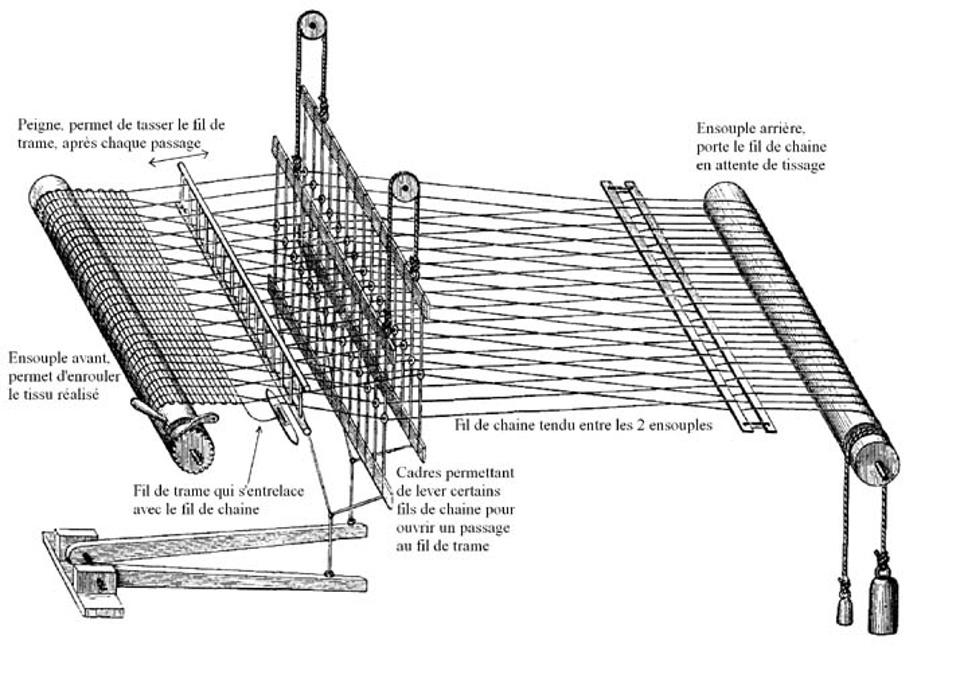
The operation of a weaver, showing the upper weaver's beam and the two counterweights: http://www.compagnons-duellistes.fr/wp-content/uploads/2011/04/Principe_Metier.jpg
45.05 The weaver's beam metaphor is as much about the beam itself than its weights and ropes
Of course, the metaphor of the weaver's beam about Goliath, is good enough if you only consider the shape of the windlass drive shaft of the Grand Gallery, the shaft that was operated by the hauling Beetle, and the shaft that was metaphorically operated by Goliath as well; but the metaphor doesn't stop with the design of the drive shaft, because one way of describing the full operation of that shaft, with the ropes, the weight (the impactor) and the counterweight (the hauling Beetle with the six crewmembers), precisely is to compare what happened inside the Gallery, with a real weaver and its own ropes, weight and counterweight. The metaphor is simply perfect. This is what the weaver's beam metaphor about the giant Goliath is all about.

Great Pyramid Passages and Chambers, Volume 1 (1910 edition). By John and Morton Edgar. The Edgars were associates of Charles Taze Russell and wrote this treatise in defense of Russell's views on the prophetic symbolism of the Great Pyramid of Gizeh in Egypt. This volume was advertised in the August 1, 1910 Watch Tower and was sold by the Brooklyn and London branches of the Watchtower Society. It was later revised in 1923. This was circulated among Bible Students (Jehovah's Witnesses) until 1928. Bible Students who retained Russell's teachings still circulate the volume. Plate CLVIII, page 292 "The GRAND GALLERY of the Great Pyramid of Gizeh, looking south, showing the sheer-cut-off of the floor ; and the two Ramps ascending into the darkness beyond.": https://archive.org/details/GreatPyramidPassagesVol11910Edition/page/n300/mode/1up
45.06 It is perfectly known that David and Goliath fought in a valley with 'very steep sides'...
We've already seen how Egyptians had glorified the steep sloping ramps of the Grand Gallery in the 'Amduat', where they describe "sloping passage ways for the act of towing"; and the Jewish religion is doing about the same thing, talking about "very steep sides of the valley" where David fought Goliath.
"At the time of Saul and David, the Philistines were one of Israel's most important enemies. As a people, they were skilled at working with iron forged weapons, which gave them the ability to make impressive chariots. With these chariots of war, they dominated the coastal plains but were not competent in the mountainous regions of central Israel. Why did the Israelites wait 40 days and not beginning the attacks? Everyone was afraid of Goliath. He seemed invincible. Not even Saul had stepped out to fight! But an equally important reason had to do with the characteristics of the land. The sides of the valley were very steep. Whoever made the first move would have a strong disadvantage and probably suffer great loss. Both sides were waiting for the other to attack first." https://www.onepagebiblesummary.com/bat/bat_05.php
45.07 And that David kept going 'back and forth' from Saul (Saul is the seventh teammate: the leader of the team)
Probably the major difficulty in deciphering the Bible, is that there are so many distracting data that it is very hard to find the genuine information and to understand its importance; but it really is the case here. We know that if there was six crewmembers operating the Beetle, there also was a leader who stayed at all times on the platform; the leader was the seventh of the team, the seventh of the Seven Scorpions of Isis. So, when the hauling Beetle kept moving up and down, so did David and by consequence, he also kept going back and forth from the leader, Saul.
"Now David was the son of an Ephrathite of Bethlehem in Judah, named Jesse, who had eight sons. In the days of Saul the man was already old and advanced in years. The three oldest sons of Jesse had followed Saul to the battle. And the names of his three sons who went to the battle were Eliab the firstborn, and next to him Abinadab, and the third Shammah. David was the youngest. The three eldest followed Saul, but David went back and forth from Saul to feed his father's sheep at Bethlehem. (1 Samuel 17:12-15)": https://www.christianity.com/wiki/bible/bible-story-of-david-and-goliath-1-samuel-17.html

45.08 The five little stones that David is carrying with him to fight Goliath are his five teammates in the Beetle
There are many explanations you can read on the internet about why did David took five little stones from a brook before his fight with Goliath, but of course none is correct. We know that the whole team operating the Grand Gallery was made of seven teammates and that Saul and David were part of that team; in other words, there are exactly five teammates missing… and of course they are the five little stones. There are at least two metaphors that have been used for these stones:
• the counterweight metaphor: when you think it through, the operation of the impactor was finally pretty close to the operation of a scale, with the weight of the impactor that needed to be opposed with another weight, a counterweight; and the Beetle with its crewmembers was this counterweight; so if you are missing 5 crewmembers, you also are missing five little counterweights, i.e. five little stones
• the board game metaphor: this is my favorite I have to admit, because one way of looking at the crewmembers inside the Beetle, would be to compare them as the stones you can use on a board game, simply because each and every single crewmember would have had to be like "imprisoned" inside his own little "cell"… or his own little "square" on a game grid on which you would put a little stone.
Then he took his staff in his hand, chose five smooth stones from the stream, put them in the pouch of his shepherd’s bag and, with his sling in his hand, approached the Philistine. 1 Samuel 17:40 New International Version (NIV): https://www.bible.com/bible/compare/1SA.17.40
"Go is an abstract strategy board game for two players in which the aim is to surround more territory than the opponent. The game was invented in China more than 2,500 years ago and is believed to be the oldest board game continuously played to the present day. A 2016 survey by the International Go Federation's 75 member nations found that there are over 46 million people worldwide who know how to play Go, and over 20 million current players, the majority of whom live in East Asia. The playing pieces are called stones." https://en.wikipedia.org/wiki/Go_(game)
Board Games, "How to Play Checkers", co-authored by J. Davidson: https://www.wikihow.com/Play-Checkers

David, with a sling, kills Goliath. David took out a stone from his shepherd's bag, slung it and struck the Philistine in the forehead, so that the stone sunk into his forehead, and he fell down upon his face to the earth. Illustration for The Psalms of David (Fleming H Revell, 1900), illustrated by Louis Rhead. Extracted from public domain version of above work by Mike Cline: https://en.m.wikipedia.org/wiki/File:DavidandGoliath.JPG
45.09 Because the hauling Beetle was like a giant beast lying flat and face down in the Grand Gallery, so David had to kill and get Goliath lying on the ground and face down as well
It's one thing to represent the hauling Beetle into some kind of giant, because of its size, but the problem is that the Beetle wasn't standing up in the Grand Gallery, it was lying flat on the ground, just like a beetle scarab moving backwards down the Gallery. So, what did the 'authors' who created all these extraordinary glorifying stories do? Well, they imagined that one of the crewmembers of the hauling Beetle would kill the giant; and how would he killed the giant? Well, because the crewmembers could be seen as little stones on a board game, they've used the stone metaphor: the six crewmembers would become stones, and it is one of these stones which is gonna kill the giant.
Remember that the crewmembers didn't stay still inside the hauling gantry, but that they constantly get in and out of it between each hauling cycle. In other words, they constantly had to jump in the gantry; and if six persons do that to a giant, chances are you make the giant to fall.
One other thing, is that if you look at most of the representations of the killing of Goliath by David, you'll see that Goliath is systematically more or less on his back, and that's what should happen, because if David is striking the giant with a stone in the forehead, then he should indeed fall on his back, because of the impact; just like when you see someone being shot by a firearm, the victim is thrown backwards. But this is not what is described in the Bible: Goliath is supposed to fall face down, and if he does it is only because Goliath really is the hauling Beetle of the Great Pyramid, and that it was supposed to lay flat on the ground, face down.

Operating diagram of the Great Pyramid of Giza, showing the central role that took the Grand Gallery where the hauling Beetle was constantly being operated to bring back the impactor to the top of the Gallery at the end of every new cycle of pressurization of the whole system.

David playing the harp before Saul, King of the Israelites. Look at how David seems to be trying to get to Saul, raising himself up with the strings (the ropes) of the harp. Painting by Julius Kronberg (1885) at the Nationalmuseum (National Museum of Fine Arts in Stockholm, Sweden), slightly edited for enhanced clarity: https://commons.wikimedia.org/wiki/File:David_and_Saul_(Julius_Kronberg)_-_Nationalmuseum_-_18384.tif
45.10 If the weaver's beam metaphor about Goliath is perfect to describe the operation of the windlass of the Grand Gallery, the harp metaphor is perfect when it comes to the ropes and the central wooden caisson
I'm really sorry to say that just like in the ancient Egyptian religion, everything that is written in the Bible is only metaphorical; metaphors are the real secret, and they are plenty of them about David; one of them being is exceptional ability to play the harp. I know it demands a lot of effort to imagine ourselves inside the Grand Gallery, 4,500 years ago when the Beetle was still being operated by the six crewmembers who were on board, but you should really take the time to do so: imagine the atmosphere, imagine the sound of fresh air filling up the central wooden caisson through the lower hatch at the northern end of the Gallery, and imagine what kind of sounds the four ropes under tension would have created inside the central wooden Djed caisson. The Djed caisson would have sounded like a sound box!
Here, on the above painting, there is just a little problem: the kind of harp David is playing doesn't really match the description that is made in the scripture, where it is the wind that is playing the harp.

Operating diagram of the Grand Gallery of the Great Pyramid of Khufu, showing the two Staffs of Aaron and Moses: respectively a windlass driving shaft and a guiding shaft made of four Egyptian redirecting pulleys 100% made of granite. In many ways, the impactor was more or less operated just like the anchor on a modern ship. The central wooden Djed caisson and the ropes are the origin and the true meaning of the story of David's harp played by the wind coming from the North.
45.11 King Saul didn't fight Goliath because the team leader of the Gallery didn't get inside the Beetle
If I'm right about the hypothesis that it is some ancient Egyptian heretic priest(s) who wrote the Bible, with the idea of banishing the pharaoh's influence out of the everyday life of the Egyptian people; i.e. giving to the people a completely independent religion of their own, then the problem of the origin of this religion (the fact that it entirely rely on the operation of the Great Pyramid) really doesn't matter that much. What was important was to reinterpret what was already known by the people because of the ancient Egyptian religion, and build en entire new religion that would have made them a real community, sharing common stories and values.
The David and Goliath story is probably one of the most famous of these stories, and you can find on the internet endless numbers of sites explaining all the values which are applying to the story, and in particular why Saul didn't accept Goliath's challenge to fight. What I'm describing here, is just what is the original historical event on which the story was built, but again: it is very important to me, but it doesn't have to be that way for anyone engaged into the Jewish religion. It is actually exactly the same thing that you do when you drive your car; you don't need to know every single piece of the car, nor you need to know how and why a piece is working with all the other pieces: you just need to know how to drive the whole thing. I'm just seeing myself as the engineer who had to design every single piece of the car, and who had to make them work properly all at the same time.
In the David and Goliath story, Saul is the king, the first monarch of Israel, but he declines the challenge to fight Goliath; and what I'm explaining here, is only what is behind the scene: if King Saul didn't fight Goliath, it is only because Saul is referring to the team leader of the Grand Gallery, and if Saul refused to fight Goliath, it is only because the team leader of the Gallery simply wasn't supposed to get inside the Beetle.
"Saul (Hebrew: שָׁאוּל, Šāʾūl; transl. "asked/prayed for") was, according to the Hebrew Bible, the first monarch of the United Kingdom of Israel. His reign, traditionally placed in the late 11th century BCE, supposedly marked the transition of Israel and Judah from a scattered tribal society ruled by various judges to organized statehood. The historicity of Saul and the United Kingdom of Israel is not universally accepted, as what is known of both comes exclusively from the Hebrew Bible" https://en.wikipedia.org/wiki/Saul
"In 1 Samuel 17, Saul and the Israelites are facing the Philistines in the Valley of Elah. Twice a day for 40 days, morning and evening, Goliath, the champion of the Philistines, comes out between the lines and challenges the Israelites to send out a champion of their own to decide the outcome in single combat, but Saul is afraid. David accepts the challenge. Saul reluctantly agrees and offers his armor, which David declines, taking only his staff, sling, and five stones from a brook. […] The underlying purpose of the story of Goliath is to show that Saul is not fit to be king (and that David is). Saul was chosen to lead the Israelites against their enemies, but when faced with Goliath he refuses to do so". https://en.wikipedia.org/wiki/Goliath

Aeolian harp, with the strings of the instrument passing over the wooden structure of the box, with two holes for the air. "Aeolian harp, four-sided box of thin spruce wood. On the front side two round sound holes, end pieces run slightly over the sides and form a stand and string holder, 5 strings with wooden screws." Blekinge museum collection at Karlskrona, Sweden: https://blm.kulturhotell.se/objects/c32-7220/
45.12 The harp played by David is an eolian harp, the kind of harp played by the wind
The above artifact is called an aeolian harp box; it is the kind of harp that is supposed to be played by the wind, and it is exactly the kind of harp that would make comprehensible the story of David and his own harp that is played by the wind. In other words, David's harp has nothing to do with the kind of harp we all have in mind, the kind of harp that is played during concerts.
"According to ancient tradition, King David possessed a special harp that he hung above his bed. At midnight, a north wind would come and blow upon it — and the harp would start to play. David would immediately arise and study Torah until the break of dawn. (Berachot 3b)." https://ravkooktorah.org/SHIR64.htm#:~:text=David's%20Harp,(Berachot%203b).

An aeolian harp with the strings passing through the inside of the wooden box, made by Robert Bloomfield between 1812 and 1823. The Higgins museum and gallery, Bedford. Picture by Simon Speed: https://en.wikipedia.org/wiki/Aeolian_harp#/media/File:BloomfieldAeolianHarp.JPG
45.13 If David's 'special hanging harp' is described just like an aeolian harp, it is because it is only referring to the central wooden caisson 'hanging' down inside the Grand Gallery from the top platform
We've already seen that ancient Egyptians already had glorified this particular part of the operation of the Gallery, in the Lamentations of the Twin Sisters Isis and Nephthys, but the Bible is much more explicit, because it is the very origin of the story of the north wind blowing upon King David's harp. The metaphor is simply beautiful: the four ropes of the Grand Gallery being compared to the strings of a harp and played by the wind; but the metaphor doesn't stop there because a harp also has a wooden soundboard, and because the Grand Gallery had its own with the central wooden caisson.
Also, it is said that the 'special harp' of David 'hung' above his bed, and what a very good metaphor to describe the fact the central wooden caisson was so steep that it looked like it was hanging from a wall. Even better: every soundboard has at least one hole to let the sound get out of the instrument, and of course the central caisson has its own hole with the lower hatch. And then it continues with another metaphor, and this time it is pretty much the same one we've already seen when Ezekiel is supposed to eat an unrolling scroll; here it is David that is literally 'unrolling the scroll' (i.e. unwinding the ropes), when he is pictured 'studying the Torah'.
"According to ancient tradition, King David possessed a special harp that he hung above his bed. At midnight, a north wind would come and blow upon it — and the harp would start to play. David would immediately arise and study Torah until the break of dawn. (Berachot 3b)." https://ravkooktorah.org/SHIR64.htm#:~:text=David's%20Harp,(Berachot%203b).

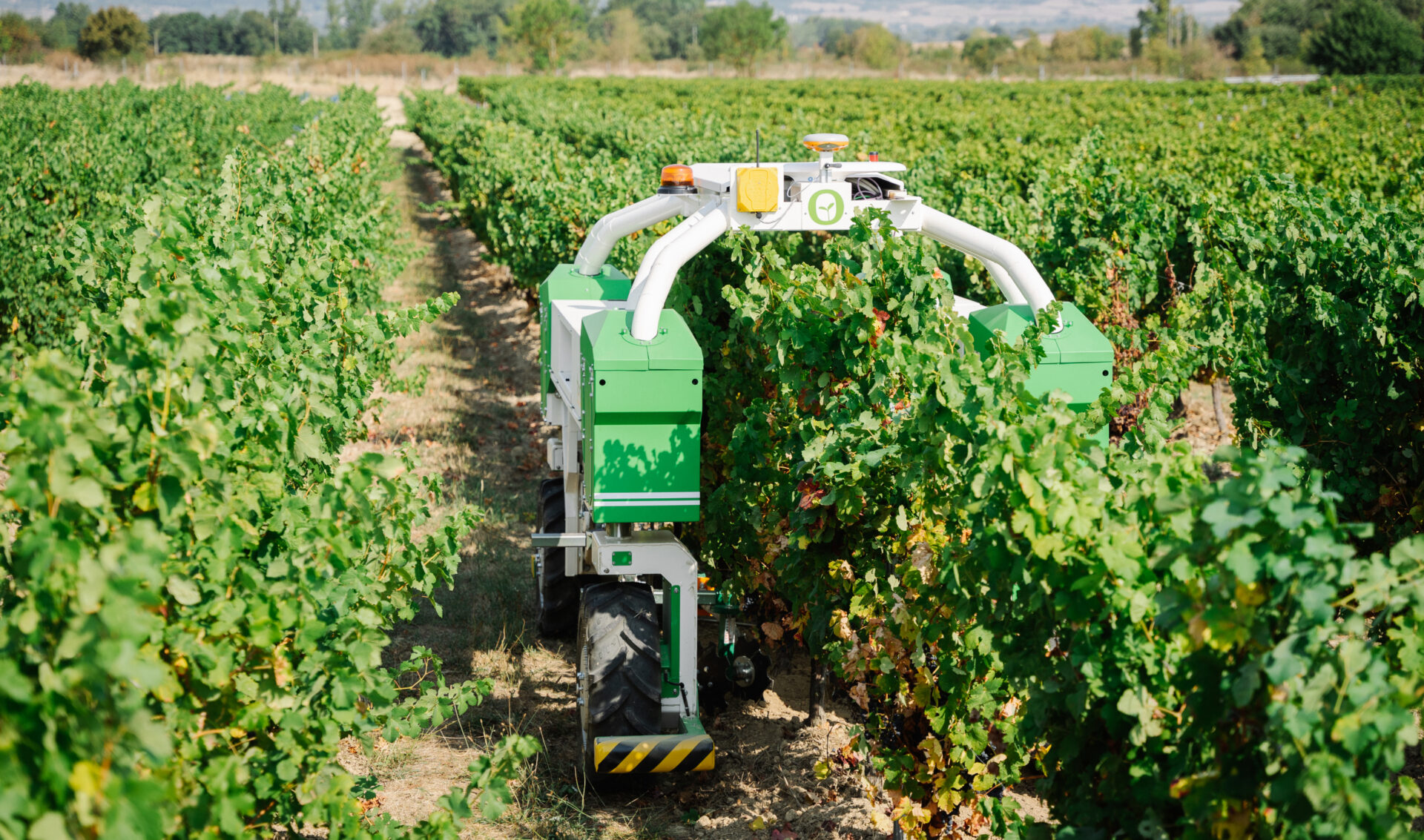
High clearance vineyard tractor, thanks to https://www.naio-technologies.com/ [this image] https://www.naio-technologies.com/wp-content/uploads/2021/04/intro-ted-desktop@2x-1920x0-c-default.jpg
45.14 The perfect modern model of the hauling Beetle is the vineyard high-clearance tractor: a beast with no head
Maybe it is the former winemaker talking here, but indeed, if we want to find a modern metaphor about the hauling Beetle of the Great Pyramid (and certainly many of these hauling gantries would have been built in pharaonic times), maybe the kind of tractors working in vineyards and passing over the top of vine rows would be a good example. Just substitute the vine row with the central wooden Djed caisson, and voila!
• the two lateral parts only connected at the top
• the central connecting section (imagine there is a central hole in the white structure: that is the lower hatch)
• a body without a head at the top: you could have only seen the legs

Operating diagram of the Great Pyramid of Giza, showing the lower hatch of the central wooden Djed caisson, glorified into Ptah. The hatch had a metal sliding door that disappeared inside what is called a 'cavern' meant in modern boat designs to protect the sliding door when the hatch is open and that was operated pretty much like a guillotine. This had been used in the myth about David and Goliath, where David cut off the head of the giant.
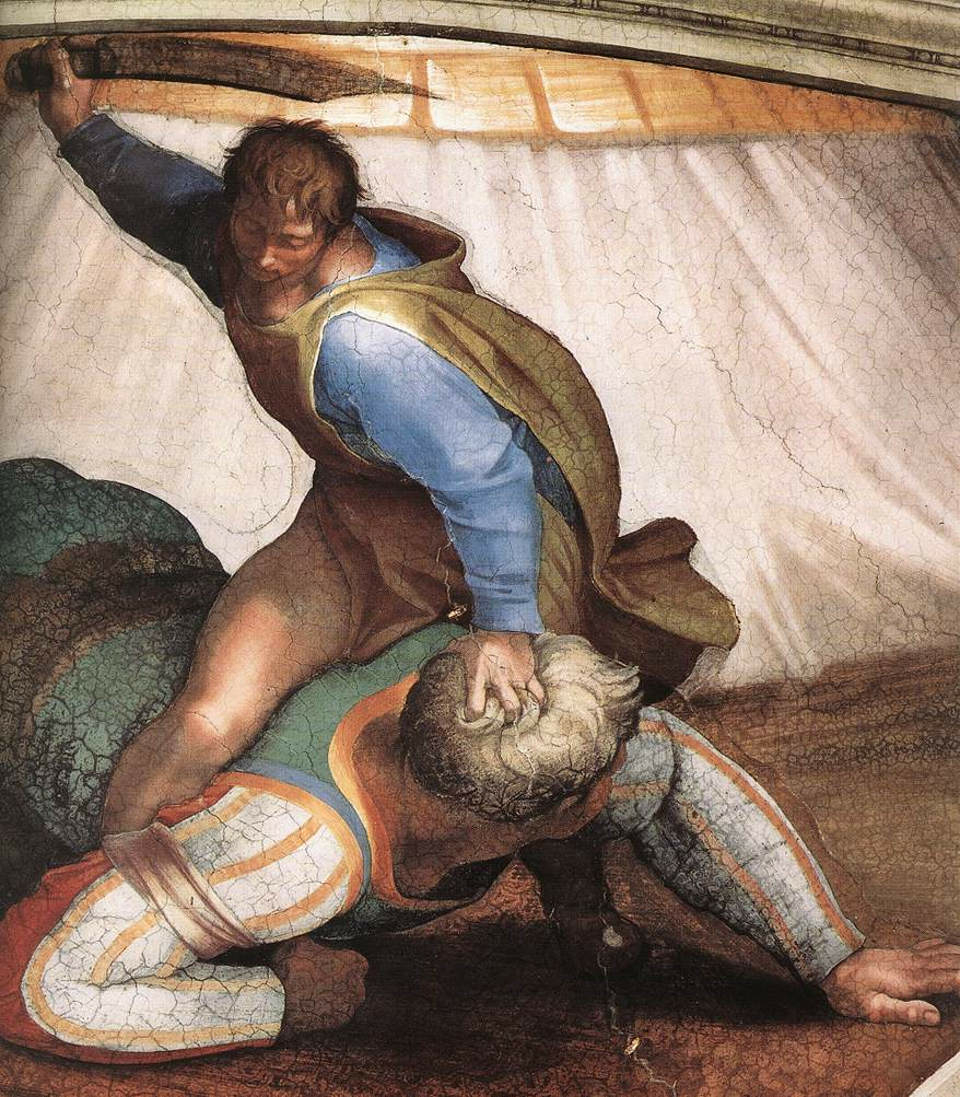
David and Goliath by Michelangelo, on the Sistine Chapel ceiling, with Goliath laying face down on the ground despite the sling shot in the forehead: en.wikipedia.org/wiki/Goliath#/media/File:Michelangelo,_David_and_Goliath_02.jpg
45.15 The hauling Beetle was only a flat gantry and didn't have any head, so David had to cut Goliath's head
The metaphor of the weaver’s beam we’ve already seen is extremely interesting, and not only because of the operation of the windlass; the operation of the Grand Gallery itself is perfectly well reinterpreted in the operation of the weaver’s shuttle, this piece of equipment constantly moving up and down when attached with strings or ropes. The weaving metaphor is perfect.
But there is another obvious metaphor, and it is the fact the hauling Beetle, if it looked like a beast or a giant laying flat on the ground, simply didn’t have any head! It’s like someone had cut off its head! So, of course, at some point in the myth, David also has to cut off the head of Goliath.
Sliding hatch door, functioning just like a guillotine: skills.woodenboat.com/books/hatches-and-other-deck-joinery/

45.16 The misinterpreted 'contradictions' about David and Goliath: was there really two of them, and what was their height
There is inside the David and Goliath story, a real imbroglio that scholars are obviously unable to resolve once and for all: everybody has his own opinion on the subject; but once again, it is only the consequence of a literal reading of the Bible. And you can take the problem any way you want, if you stick to the literal interpretation of the scripture, you'll not be able to make up your mind definitely: contradictions won't go away.
• first, people are not sure who really killed Goliath: was it David, or another man named Elhanan?
• second, people are not sure either if there was only one Goliath, or if the Giant also had a brother, named Lahmi.
• third, people aren't even sure of the size of Goliath: was he 4 cubits and a span high or 6 cubits and a span high?
"Some claim that a contradiction exists between 1 Samuel 21:9; 2 Samuel 21:19 and 1 Chronicles 20:5, because it appears two different people killed Goliath. The question is, “Who killed Goliath?” Did David or Elhanan kill Goliath, or did both? […] So, who killed Goliath? David or Elhanan? The third part to the answer is that since events in 1 Samuel 17 and 1 Chronicles 20 occurred about 44 years apart, there is sufficient and necessary reason to conclude that Elhanan killed Lahmi the brother of Goliath, in 1 Chronicles 20. The description of the events are different, the events occurred about 44 years apart, and scripture records there were other giants in the land. Therefore, the answer is that David killed Goliath. Elhanan killed his brother Lahmi." https://www.neverthirsty.org/bible-qa/qa-archives/question/who-killed-goliath-david-elhanan/
"In 2 Samuel 21, verse 19, the Hebrew Bible tells how Goliath the Gittite was killed by "Elhanan the son of Jaare-oregim, the Bethlehemite". The fourth-century BC 1 Chronicle 20:5 explains the second Goliath by saying that Elhanan "slew Lahmi the brother of Goliath", constructing the name Lahmi from the last portion of the word "Bethlehemite" ("beit-ha’lahmi"), and the King James Bible adopted this into 2 Samuel 21:18–19, but the Hebrew text at Goliath's name makes no mention of the word "brother". Most scholars dismiss the later 1 Chronicles 20:5 material as "an obvious harmonization" attempt." https://en.wikipedia.org/wiki/Goliath
"The oldest manuscripts, namely the Dead Sea Scrolls text of Samuel from the late 1st century BCE, the 1st-century CE historian Josephus, and the major Septuagint manuscripts, all give Goliath's height as "four cubits and a span" (6 feet 9 inches or 2.06 metres), whereas the Masoretic Text has "six cubits and a span" (9 feet 9 inches or 2.97 metres). Many scholars have suggested that the smaller number grew in the course of transmission (only a few have suggested the reverse, that an original larger number was reduced), possibly when a scribe's eye was drawn to the number six in line 17:7." https://en.wikipedia.org/wiki/Goliath
[above illustration] David and Goliath, a color lithograph by Osmar Schindler (c. 1888): https://en.wikipedia.org/wiki/Goliath#/media/File:Osmar_Schindler_-_David_und_Goliath.jpg
45.17 There isn't any contradiction anymore if you know Goliath is the hauling Beetle: it was made of two separate but connected parts, and of course it both had a height and a width
• first and second, if it is correct to talk about one Goliath, just like it is correct to talk about one hauling Beetle, it would be preferable to only talk about the two separate half-Beetles: there were indeed two giants hauling structures in the Grand Gallery. But even if it is probably still possible that these two half-Beetles weren't physically connected with each other after all, they were most probably really connected into one single structure. In other words, Goliath could have been seen either as one single Giant all by himself, or as a pair of Giants, and this is where the second Giant Lahmi, Goliath's brother comes into play.
• third, there doesn't have to be a contradiction in Goliath's height either: because Goliath isn't a man but a wooden gantry you could actually give both his height and his width. Probably the 4 cubits and a span are about its width, and 6 cubits and a span are about its height.
But then, there is another problem: the width of the Grand Gallery being 4 cubits, how could the Beetle be 4 cubits and one span width? First, there could be a problem with the unit itself. Which 'cubit' unit is the Bible using in the David and Goliath story? Because there are many cubits, really. Of course if the cubit used is a 'small' cubit, then there is no more problem, but even if the units are the same, there still could be an explanation: remember that everything in the ancient Egyptian religion and in the Bible is metaphorical, and that in particular they both like to play with words, with numbers and with units (remember the 360 degrees in a circle, in the ancient Egyptian myth which had been compared to the 365 days of a year, just to play with these two very close numbers that are 360 and 365); so when it is said that the height of Goliath was either 4 cubits and a span, or 6 cubits and a span, the mention of the extra span is suspicious.
If they loved so much to play with words and metaphors, they could have simply wanted to add the word "span" to the 4 and 6 numbers. For example, let's say the Beetle was really 4 cubits wide, and that you simply wanted to add to the story, as a little bonus, that you could only have slide you hand in the space between the wooden structure of the Beetle and the walls, then you would have simply add the term 'span' to the genuine 4 cubits data. Of course, this is not even a theory, simply kind of an exercise in style to try to illustrate the difficulty to use the two different heights of Goliath found in the Bible. The most important is to understand that they are not contradictory at all, but that they are complementary, even if it will be very difficult to be sure of anything about their interpretation.

45.18 The true meaning of the Star of David is about the hauling team of the Beetle: the six crewmembers that were inside the gantry and arranged in two sets of three, plus the seventh one, the leader of the team himself, Saul
The Star of David has become one of the most known symbol in the entire modern world, and now that we know what really is representing David, we can also decipher the Star of David. Everybody knows that part of the meaning of the Star of David is about the glorification of the number 6 (because of the hexagram), and the number 7 (because of the central point of the hexagram). But the most important part of the Star of David, is the fact that the so-called hexagram isn't really an hexagram, instead it is the association of two interlocked triangles; in other words, the main part of the Star of David isn't really just the glorification of the number 6, but twice the glorification of the number 3.
So, this is the Star of David, and we know now who really was David, the most important crewmember of the hauling Beetle of the Great Pyramid: the one who had to get inside the central wooden caisson to reattach the impactor with the hauling plug. Operating the Beetle, they were six teammates, arranged in two sets of three. Knowing that now, you don't have to be a genius to understand what the Star of David is really all about: the glorification of the hauling team of the Great Pyramid.
[illustration] The Star of David as depicted on the flag of Israel. "The Star of David, the symbol of the Jewish faith and people. Also called Shield of David after the Hebrew Magen David.", by Zscout370: https://en.wikipedia.org/wiki/Star_of_David#/media/File:Star_of_David.svg

45.19 The Star of David is also known as the Shield of David because a beetle scarab does have a protective shield of its own: its exoskeleton
So far, we've already seen two ways of describing David and his five teammates working into the Beetle:
• you can compare them to prisoners in their individual cells
• you can compare them to stones into the squares of a game board
• you can compare them to rats caught inside traps in a sewer
• but you can also described them as being protected by some kind of shield; and this is this metaphor which has been used in the Star of David: The Star of David as depicted on the flag of Israel. "The Star of David, the symbol of the Jewish faith and people. Also called Shield of David after the Hebrew Magen David." https://en.wikipedia.org/wiki/File:Star_of_David.svg
Even if a scarab Beetle isn't literally what is called a shieldbug, or shield bug, this is the very metaphor which has been used for the hauling Beetle in its Shield of David reinterpretation: the Shield of David/Star of David is about the structure of the wooden hauling gantry Beetle, just like the exoskeleton of the Scarab Shieldbug: https://www.naturespot.org.uk/species/scarab-shieldbug
Of course, like all insects, scarab beetles come with 6 legs; when you think it through, the scarab beetle metaphor of the hauling gantry of the Grand Gallery, simply is perfect and sublime.
Scarab Shield by nith47: something-wicked.fandom.com/wiki/Scarab_Shield?file=Scarab_shield_by_nith47.png
45.20 The Seal of Solomon (from which originates the Star of David) was indeed about giving power
"The Seal of Solomon or Ring of Solomon (Hebrew: חותם שלמה, Ḥotam Shlomo; Arabic: خاتم سليمان, Khātam Sulaymān; Turkish: Mühr-ü Süleyman) is the legendary signet ring attributed to the Israelite king Solomon in medieval mystical traditions, from which it developed in parallel within Jewish mysticism, Islamic mysticism and Western occultism. It is often depicted in the shape of either a pentagram or a hexagram. In religious lore, the ring is variously described as having given Solomon the power to command the supernatural, including shedim and jinn, and also the ability to speak with animals. Due to the proverbial wisdom of Solomon, it came to be seen as an amulet or talisman, or a symbol or character in medieval magic and Renaissance magic, occultism, and alchemy." https://en.wikipedia.org/wiki/Seal_of_Solomon

Interior of a Goliath, SdKfz. 303, showing the petrol engine, control cable reels and the space for the warhead. Thanks to the US Department of Ordnance. Catalog of Enemy Ordnance Manual, 1945 Goliath German remote controlled tracked vehicle opened, interior, fuel powered: https://en.wikipedia.org/wiki/Goliath_tracked_mine#/media/File:Goliath-interior.jpg
45.21 The worthy successor of the hauling Beetle: the "Goliath Beetle tank"
This is so funny to see that even today, we are still using the exact same metaphors that the ancient Egyptians have used 4,500 years ago, when some tanks named Goliath, were known as 'beetle tanks'! Isn't that inspiring?
"The Goliath tracked mine (German: Leichter Ladungsträger Goliath, "Goliath Light Charge Carrier") was a series of two unmanned ground vehicles used by the German Army as disposable demolition vehicles during World War II. These were the electrically powered Sd.Kfz. 302 and the petrol-engine powered Sd.Kfz. 303a and 303b. They were known as "beetle tanks" by the Allies." https://en.wikipedia.org/wiki/Goliath_tracked_mine

45.22 How ancient Egyptians themselves glorified the seven teammates of the Grand Gallery: the myth of Isis and the seven scorpions
I have some kind of special relationship with the myth of Isis and the Seven Scorpions, not because you can rely on it to support many things about how was operated the Grand Gallery, the myth is so hard to decipher and maybe there is a lot of the myth that doesn't have any correlation with the Great Pyramid at all; but this is very important for me, because it is that myth that allowed me to realize there was six crewmembers operating the hauling Beetle. This crucial information, got only later confirmed by the Jewish reinterpretation of the Beetle into Goliath.
So what can we find here, from a very kind of superficial look of the myth:
• references about the fact they were indeed six crewmembers
• references about the fact that one of them was supposed at some point to 'creep' beneath a door
There is nothing much to get, but I find interesting to show that to you, and well there is still that reference to the one crewmember who had to slide open the hatch door, and get inside the central wooden Djed caisson. So now, we have the name of the glorification of that sixth crewmember with a very special role: his name was Tefen (just to be clear, the name Tefen here, isn't about one man, it's about one function in the team; it's the equivalent of a 'pilot', or 'navigator' or 'engineer').
The following excerpt is from a post written by Joshua J. Mark, a freelance writer and former part-time Professor of Philosophy at Marist College, New York: https://www.worldhistory.org/Serket/
"One of the most popular stories concerning Isis is known as Isis and the Seven Scorpions. It relates how, when Horus was an infant and Isis was hiding him in the swamp lands, Serket had seven scorpions keep her company. When Isis went out to beg for food in the nearby towns, three of them - Petet, Tjetet, and Matet - would go before her to make sure the way was safe and Set was not waiting in ambush, two were on either side of her - Mesetet and Mesetetef - and two brought up the rear - Tefen and Befen, who were the most fierce - in case Set chose to attack from behind".
"Whenever she left the swamp, Isis would conceal her glory so she looked like a poor, older woman asking for alms. One night, as she and her bodyguard entered the town, a very rich noblewoman looked down on them from her window and quickly slammed her door and locked it. Serket, though watching over Horus in the swamp, could see all that her scorpions saw, and she was angered at this affront to Isis. She decided the woman would pay for the insult and sent a message to Tefen that he should take care of the situation. The other six scorpions all surrendered their poison to Tefen who drew it up into his stinger and waited for the right moment. In the meantime, a poor peasant woman had seen the noblewoman refuse hospitality and, even though she had little, offered Isis and her scorpions a place under her roof for the night and a simple meal".
" While Isis was eating with the young woman, Tefen snuck out of the house and crept beneath the door of the home of the noblewoman, where he stung her young son. The boy fell down in a stupor, and the noblewoman grabbed him up and tried to revive him but could not. She ran into the streets, crying for help, and Isis heard her. Even though the woman had refused her food and a place for the night, Isis forgave her. She did not want the boy to pay for his mother's insult. Isis took the child in her arms and called each of the scorpions by their secret name, thereby dominating them and neutralizing their power, and recited spells of great magic. The poison evaporated, leaving the child's body, and he revived. The noblewoman was so grateful and so ashamed of her earlier behavior, she offered all her wealth to Isis and the peasant woman. Serket, back in the swamp with Horus, regretted having sent the scorpion to attack the innocent boy and vowed to protect all children in the future".
[illustration] “Isis and The Seven Scorpions”, by Tom McNeely. Picture Window Books”: https://www.amazon.fr/Isis-Seven-Scorpions-Tom-McNeely/dp/1404871500

Papyrus or papyriform funerary boat towed on a sled by six men, after Davies and Gardiner, The Tomb of Antefoker (1920), pl. XIX. "TT60 is the burial place of a woman called Senet. She was related to the ancient Egyptian Vizier Intefiqer (mother or wife). It is one of the earliest burials in the area. Intefiqer was Governor of the city (i.e. Thebes) and Vizier of Senusret I in the 12th Dynasty". Source [text]: https://en.wikipedia.org/wiki/TT60

45.23 How ancient Egyptians themselves glorified the six teammates of the hauling Beetle: by representing the six crewmembers twice, both in their active and inactive phases
One of the most important things to keep in mind about the way ancient Egyptians used to apprehend the way nature was functioning, and by extension the way they've chosen to glorify their scientific and technological accomplishments, is the idea of two opposite but complementary 'active' and 'inactive' phases in a cycle or in a piece of equipment (the inactive Bastet and active Sekhmet in their glorification of the check valve with counterweight). This is what the famous Maa't is all about: balance between the active and inactive sides in a cycle.
What we have here, with the two sets of six characters is probably exactly that: first, the representation of the six active crewmembers really in the act of hauling; and just next to them, the second set of inactive crewmembers, with their hands in the air to demonstrate that they are under no circumstance touching the rope. It doesn't mean they will never touch it, because they will actually do it in the next part of the cycle; it is just that right now: "I am not touching that rope!".
One of the reasons scarabs were revered in ancient Egypt is that the hauling gantry used to operate the impactor of the Great Pyramid of Khufu, and almost certainly much more similar gantries elsewhere in Egypt, resembled a scarab, moving backward. Sacred scarab beetle © Encyclopædia Britannica: https://www.britannica.com/animal/scarab-beetle

The obsession of ancient Egyptians for perfect balance, the famous Maa't, comes from their fundamental viewing that everything can be seen as either in an active phase or in an inactive phase. Here on this metaphoric representation, it is about the six active and inactive crewmembers of the hauling Beetle. Don't think that the hauling process represented here is real; it's really not: the whole point of the scene is to glorify the hauling Beetle that was operated in the steep slope of the Gallery. There wasn't any sled either: Egyptians only used the sled as a metaphoric tool to glorify and hide at the same time the fact that what they really used to move heavy things only looked like they were using sleds, when they were actually using metal skate blades running through wet hollow wooden guide rails.
45.24 The two sets of six crewmembers of the hauling Beetle: six active and six inactive crewmembers
• On the left, the six active crewmembers: "Excuse me, but I'm working here! We'll talk tomorrow!"
• On the right, the same but inactive six crewmembers: "Nope! I'm not touching that rope, I'm done for the day!"
What it means is that on this single image, the hauling Beetle is actually also represented twice: the right side of the image is about the active and inactive phases of the hauling process (the Beetle moving up and down the Gallery), while the left side is a represention of the Beetle itself.
45.25 The ancient Egyptian well known principle of 'inactivity or repose'
This obsession that ancient Egyptians had in the idea of glorifying everything in either a 'active' or 'inactive' part of a cycle or piece of equipment, is actually already known by egyptologists who are talking about the 'principle of inactivity or repose'. But this principle of inactivity or repose cannot be seen all by itself: it also has to be associated with its active counterpart, and they are both ruled by the principle of balance, Maa't.
About goddess Amunet: "Her name, jmnt, is a feminine noun that means "The Hidden One". She is a member of the Ogdoad of Hermopolis, who represented aspects of the primeval existence before the creation: Amunet was paired with Amun—whose name also means "The Hidden One", with a masculine ending (jmn)—within this divine group, from the earliest known documentation. Such pairing of deities is characteristic of the religious concepts of the ancient Egyptians. In early concepts known as the Ogdoad, the primeval deity group to which they belonged as "Night" (or as the determinative D41 meaning "to halt, stop, deny", suggesting the principle of inactivity or repose), was composed of four balanced couples of deities or deified primeval concepts. Speculation exists that Amunet may have been conceived by later theologians as a complement to Amun, rather than being an independent deity originally, however, the Pyramid Texts, the earliest known religious texts of Ancient Egypt, mention "the beneficent shadow of Amun and Amunet": O Amun and Amunet! You pair of the gods, who joined the gods with their shadow." https://en.wikipedia.org/wiki/Amunet





© 2021-2025 Copyright milleetunetasses.com. All rights reserved.
