THE PYRAMIDS of the COLD • Chapter 22 The Great Pyramid's composite impactor: the Osiris weight in the wooden vessel Ra
Publié par Bruno Coursol dans The Pyramids of the Cold le 21/09/2025 à 06:38

The entire operation of the Great Pyramid of Khufu, was centered on the composite impactor that was endlessly moving up and down into the central wooden Djed caisson that run in both the Grand Gallery and the inclined well. When Ra has been created to glorify the wooden vessel part of the impactor (hence the solar boat of Ra), Osiris has been created to glorify the weight of that impactor, the weight that gave all its force, power and energy to sun god Ra. In other words, on the above images, Osiris isn't really standing on a block that looks like a step tool: Osiris is that block. Ancient Egyptians have only used metaphors, play on words and visual tricks like this one a million times, to create the so-called 'Egyptian religion', that is nothing but a complete reinterpretation and glorification of scientific knowledge and technology accomplishments.
THE PYRAMIDS of the COLD • Study written by Bruno COURSOL (January 2021 to September 2025)
Section C • The composite weighted impactor of the Great Pyramid of Khufu
It is because of the impactor that both pressurized air and pressurized water could have been produced within the Great Pyramid of Khufu. Its composite nature and operating cycle is what the Osiris myth is all about.
Chapter 22 • The Great Pyramid's composite impactor: the Osiris weight in the wooden vessel Ra

In summary: egyptologists are claiming that the three massive granite blocks that form today what is called the ‘granite plug’ at the bottom of the ascending passage are herses, granite plugs that moved all the way from the top of the Gallery to the place where they are today; but no one is trying to explain how did they get there, how did they move, how did they slide in the central gutter of the Gallery and how did they slide inside the ascending passage itself. Because what is absolutely certain, is that if you put these massive granite blocks right on the limestone floor, of course they’ll never move an inch. But for egyptologists, it doesn’t matter. It doesn’t matter because no one cares. In real life, if you want to use an impactor to pressurize the air of the central wooden Djed caisson, and the water of the inclined well, you do have to demonstrate some intelligence so that it could have been able to move, slide and gain speed and energy. But you also have to take into consideration the need to handle that impactor as well: it had to go down the Gallery, but it also had to be hauled back up.
So, ancient Egyptians designed a composite impactor that was basically a wooden structure, but hollowed out so that a weight could have been embedded inside. That weight is Osiris, and because the wooden structure was its transportation vessel, the wooden part of the impactor has been glorified into Ra, hence the association of Ra and his famous barque: there is no barque or boat of Ra; because Ra is that boat.

Operating diagram of the Great Pyramid of Khufu, showing the central role of the composite weighted impactor that run in both the central wooden Djed caisson to create pressurized air and in the inclined well to create pressurized water. That impactor has been glorified into many different deities, each one emphasizing a specific characteristic about how it had been made, how it looked, how it was operated, what was its purpose, and so on.

Original image of the Grand Gallery of the Great Pyramid, built by pharaoh Khufu, from page 52 of "The call of the stars; a popular introduction to a knowledge of the starry skies with their romance and legend" (1919) by Kippax, John Robert, 1849-1922: https://flickr.com/photos/internetarchivebookimages/14597229618/
22.01 The imperative need of a composite design for the impactor of the Great Pyramid
The idea of pressurizing air and water in order to produce a fog of microdroplets of liquid water that would endlessly, cycle after cycle, evaporate and create cold though a flash-evaporative process, imply the use of an impactor of some kind that would be first dropped inside an airtight caisson to pressurize air in the Grand Gallery, and then that would pressurize the water in the inclined well. But the problem is to design an impactor that is heavy and efficient enough to do the job, but also easy enough to operate, and this is why the impactor couldn't just have been a simple weight: Egyptians had to insert this weight into a wooden cradle, a simple vessel but resistant to water and repetitive shocks, designed so that it could have been easily lifted by ropes, and able to gain sufficient speed and energy when released from the top of the Gallery in the central wooden Djed caisson, with no excessive friction.

No, Osiris isn't really standing on a block that looks like a step tool: Osiris simply is that block. Statuette of Osiris Late Period ca. 588–526 B.C. at the MET: https://www.metmuseum.org/art/collection/search/546747
Statuette of Osiris" Late Period 664–332 B.C. at the Metropolitan Museum of Art, New-York: https://www.metmuseum.org/art/collection/search/545802
Figure of Osiris at the Walters Art Museum, Baltimore MD: https://art.thewalters.org/detail/36613/statue-of-osiris/
Osiris offered by the Astronomer of the House of Amun, Ibeb. Third Intermediate Period, ca. 1070–712 B.C. at the MET: https://www.metmuseum.org/art/collection/search/547898

No, Osiris isn't really standing on a block that looks like a step tool: Osiris simply is that block. Ancient Egyptians have only used metaphors, play on words and visual tricks like this one a million times, to create their glorifying so-called 'Egyptian religion', just like Bes on the images of the left: what Bes is grasping is simply himself (the pressure sensitive mechanical fuse designed to break under a predetermined pressure), and what he is standing on is its female anchoring counterpart Beset, which is still embedded in the floor of the ascending passage today.

22.02 The so many representations of Osiris standing on some kind of block are because Osiris really is that block
The Statue of Harbes “protecting a figure of the god Osiris”, is probably one of the most important artifacts we still have today for the understanding of what really is Osiris, because we’ll agree that there was no reason at all for the artist who made that statue to represent Osiris standing on that block, right? Do we at least agree on that? Why the hell is Osiris represented standing on that block, just like he was a child standing on a step tool?
But of course, because of the Osiris myth where Osiris is trapped inside a wooden coffin made to his exact dimensions, now we perfectly know what really is Osiris about, and we can also answer the question about the step tool block: Osiris simply is that block. Actually, ancient Egyptians have used again and again the same trick: representing the same thing in two different forms, whether it is about Bes grasping himself (the pressure sensitive mechanical fuse that anchored Taweret at the bottom of the inclined well) and standing on his female anchoring counterpart Beset, or whether it is about Osiris, standing onto himself, that is the weight of the composite impactor of the Great Pyramid.
[Statue of Harbes, called Psamtiknefer, son of Ptahhotep]. Harbes was an official of the pharaoh Psamtik II. "This statue depicts him protecting a figure of the god Osiris." Accession Number: 19.2.2. Late Period, Saite, 595–589 B.C. at the Metropolitan Museum of Art in New-York: https://www.metmuseum.org/art/collection/search/546748
22.03 No, Harbes isn't 'protecting' Osiris: he is demonstrating he is strong enough to lift the Osiris weight
Again, I’m gonna have to correct another academic interpretation of the gestures Egyptians are really doing, just like Isis and Nephthys aren’t really worshiping anybody because they are simply demonstrating the pushing and pulling gestures, here Harbes isn’t protecting Osiris at all, but of course because Osiris is the weight of the Great Pyramid’s impactor, he is demonstrating he was able to lift that weight. Have a good look at his posture, his arms and his hands on Osiris: he is lifting the god in the air.

22.04 The glorification of the wooden and stone composite design of the impactor in the Osiris myth
There are some excerpts of the Osiris myth, in which had been glorified the chore of the operation of the Great Pyramid: the weighted composite nature of the impactor, designed to get into the water.
What is very interesting in this myth, is that it is clearly suggested that first was designed the Osiris weight, and only then, the wooden vessel had been crafted: "Set, that Wicked One, had in secret measured the body of Osiris, and the coffer was made to fit the body of the King, for this was part of the plan." What it means is that the ancient Egyptian engineers first had to determine what power they needed in order to pressurize the air in the central wooden Djed caisson and the waters of the inclined well to get the perfect fog of microdroplets in the flash-evaporative cooling passage; and only then they were able to design the wooden coffin, then maybe the central gutter and all the rest of the Grand Gallery's design: its slope, its length, etc.
Excerpts are from Sacred Texts: https://www.sacred-texts.com/egy/ael/ael08.htm#page_41
"Set hated his brother Osiris, and he gathered to himself seventy-two conspirators […]. And they made a plan that when Osiris returned they should kill him and place Set on the throne; but they hid their plans, and with smiling faces went out to meet Osiris when he re-entered Egypt in triumph. In secret they met again and again, in secret also they prepared a coffer made of costly wood painted and decorated with rich designs and glowing colours […]. Set, that Wicked One, had in secret measured the body of Osiris, and the coffer was made to fit the body of the King, for this was part of the plan. When all was ready, Set bade his brother and the seventy-two conspirators to a feast in his great banqueting-hall. […] Then Set stood up in his place and said, "He who lies down in this coffer and whom it fits, to that man I will give it." His words were sweet as honey, but in his heart was the bitterness of evil. One after one, the conspirators lay down in the coffer with jests and laughter; for one it was too long, and for another it was too short, and for a third it was too wide, and for a fourth too narrow. Then came Osiris to take his turn, and he, all unsuspecting, lay down in it. At once the conspirators seized the lid and clapped it on; some nailed it firmly in its place, while others poured molten lead into all the openings lest he should breathe and live. Thus died the great Osiris."
"The conspirators lifted the chest, which was now a coffin, and carried it to the river-bank. They flung it far into the water, and Hapi the Nile-god caught it and carried it upon his stream to the sea; the Great Green Waters received it and the waves bore it to Byblos and lifted it into a tamarisk-tree that grew by the shore."

Operating diagram of the Grand Gallery in the Great Pyramid of Khufu, showing the role of the hauling plug in the hauling process of the impactor. The hauling plug has been glorified into cow goddess Hathor 'Mistress of the counterweight', because its first role was to act as a counterweight to get the two central hauling ropes down the Gallery to the entry of the inclined well. The ropes wouldn't have been able to descend by their own weights, so they needed a counterweight.
At this point, the shape and size of the Hathor hauling plug is unknown, and the reality of the upper hatch still hypothetical, maybe the central wooden Djed caisson didn't need it at all.

The Hathor hauling plug was not only responsible for hauling the impactor up and hauling the two central ropes down: somehow, it was also responsible for the release of the impactor from the top of the Gallery. It looks like the above scene is just about this phase of the impactor's operation. [Ani in front of Ra-Horakhty, on the solar boat] Book of the Dead of Ani EA10470,21; frame 21. British Museum: https://www.britishmuseum.org/collection/object/Y_EA10470-21

22.05 How Ra and Osiris merged together to form the single deity Ra-Osiris so that they can accomplish their task
For a very long time, I couldn't figure out what exactly was Ra representing, and I think I got confused by the academic vision of Ra, particularly about his Solar barque; but the thing is that there is not such a thing as Ra's Solar barque! Ra is the barque; Ra is the vessel that is carrying the Osiris weight through the so-called Underworld. Ra is the impactor of the Great Pyramid.
One thing we know about Ra, is that "When Ra was in the underworld, he merged with Osiris...", and because we already know that the Underworld is how ancient Egyptians described the work that was done in the Great Pyramid, and probably in all the other great pyramids and mastabas, and Osiris is the weight of the impactor, then Ra really is the wooden part of the impactor. In short, the Osiris weight was embedded inside the wooden vessel 'barque' of Ra, because Ra really is that barque. This idea of Ra and Osiris merging together is probably the most important data of all the ancient Egyptian religion, and it has to be taken literally.
"Throughout the day, Ra sailed across the sky in his barge and then descended down into the underworld at night. The sun barge now transformed into the evening barge known as the Ship of a Million Souls which picked up the newly arrived and justified dead to bring them to the paradise of the Field of Reeds. Ra at this time becomes merged with Osiris, the judge of the dead, and Osiris is seen as the “corpse” and Ra as the “soul” of the single deity Ra-Osiris."
"As this deity, Ra confers with Osiris on the deepest of levels, perhaps confirming which souls have been rightly justified before transporting them, and then traveling on through the underworld darkness toward the dawn of paradise. As the barge rolls through the underworld, it is attacked by the serpent Apophis who tries to kill Ra and prevent the sunrise. The gods onboard fight the serpent off with the help of the justified dead while, on earth, the living encourage the defenders through ritual ceremonies, channeling positive energies to strengthen those on board. Every night Apophis attacks, and every night he is defeated. Ra and his crew sail on toward dawn, the justified dead are delivered to their destination, and the sunrise was then seen as the sign that Ra was again victorious, and the Egyptians would see another day." https://www.worldhistory.org/Ra_(Egyptian_God)/
[scene with the solar barque] whose meaning could be about the impactor getting inside the inclined well (but very hypothetical): https://commons.wikimedia.org/wiki/File:Ra_Barque.jpg

The impactor of the Great Pyramid of Khufu, showing its composite structure: a wooden base that is the transportation vessel for a weight that gives all its force, speed and energy to the wooden impactor.
22.06 When "Ra becomes merged with Osiris" and Osiris is the corpse and Ra is the soul
We've seen that in the ancient Egyptian religion, everything is nothing but metaphors and the Underworld isn't different; it is absolutely not just a metaphysical idea: the Underworld is very real, it is the glorification of the internal layout of the Great Pyramid. The King's chamber, the Grand Gallery, the inclined well, the flash-evaporative cooling passage, the Queen's chamber, etc. they all together constitute the ancient Egyptian Underworld.
One particular phrase from the last excerpt is exceptional, and is explaining the role of both deities in the single deity Ra-Osiris that really was the impactor of the Great Pyramid, and maybe the impactor used in other structures prior to the Great Pyramid: "Ra at this times becomes merged with Osiris, the judge of the dead, and Osiris is seen as the "corpse" and Ra as the "soul" of the single deity Ra-Osiris."
Remember that in the Osiris myth, that is Osiris who is tricked and trapped into a wooden coffin, illustrating that Osiris is nothing but the reinterpretation and glorification of the weight of the composite impactor. Here, with the reference to Ra being the 'soul' of the single deity Ra-Osiris and Osiris being the corpse, we have another example of the obsession of ancient Egyptians for the dual active and inactive characteristic in things: there is Osiris who has weight, and Ra who hasn't. Soul doesn't have weight, but the body has. It is actually some kind of active and inactive principle that probably is the origin of the other obsession of ancient Egyptians: Maat, the perfect balance.
"Throughout the day, Ra sailed across the sky in his barge and then descended down into the underworld at night. The sun barge now transformed into the evening barge known as the Ship of a Million Souls which picked up the newly arrived and justified dead to bring them to the paradise of the Field of Reeds. Ra at this time becomes merged with Osiris, the judge of the dead, and Osiris is seen as the “corpse” and Ra as the “soul” of the single deity Ra-Osiris." https://www.worldhistory.org/Ra_(Egyptian_God)/

Seth helps Ra fight Apophis on Ra's Solar Barque. From the Herweben Funerary Papyrus (Museum of Fine Arts, Boston) - Handbook of Egyptian Mythology (Geraldine Pinch): http://secretebase.free.fr/complots/zodiac/seth/seth.htm

Operating diagram of the Great Pyramid's Grand Gallery, showing the composite weighted impactor while being hauled by the two central Isis ropes, and explaining why ancient Egyptian texts are describing Ra and Osiris 'merging' together, why Osiris was called 'asleep', 'apathetic' and 'lethargic', even though it is said it is him Osiris, who gave all his energy back to Ra, and why the so-called solar boat needed to be hauled (remember: there is no solar boat of Ra, because Ra is the boat, the transportation vessel, i.e. the wooden part of the impactor).
22.07 Why was the impactor Ra assimilated with the sun
Everybody knows that ancient Egyptians were obsessed with the notion of cycle, and with the endless cycle of operation of the impactor, they certainly got the most powerful illustration of that idea; because one way of describing the impactor’s operating cycle was to compare to the sun: just like the sun is raining in the sky, the impactor was getting up and raising into the central wooden Djed caisson, until it started getting down and disappearing into the waters of the inclined well, just like the sun disappearing into the waters of the Nile. And of course, the goal in the Great Pyramid, once the cycle has started was to continue on and on this endless cycle, just like the endless movement of the sun.
You couldn’t have seen Osiris because he was hidden inside his wooden coffin, but you could have seen the wooden vessel part of the impactor itself, and that is Ra. This is why Ra is the sun god, and not Osiris.
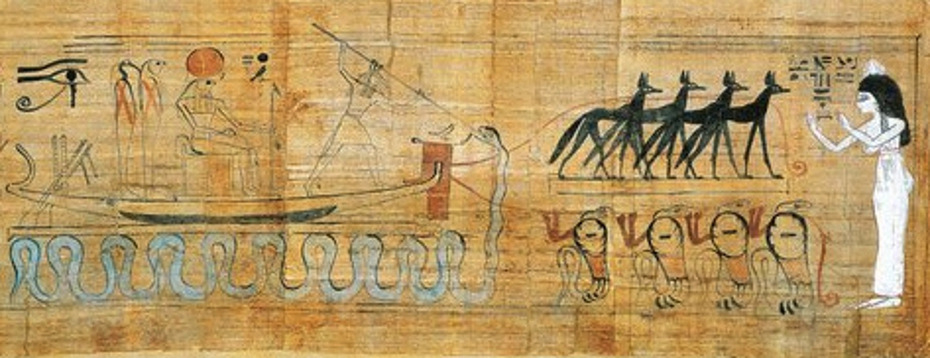
Original image of the draw: "Representation of the solar boat of Ra pulled by jackals and serpents. The boat is attacked by the serpent Apophis but the latter is pierced by Seth. Funerary papyrus of Heruben”. Soutekh67 on Wikipedia: https://fr.wikipedia.org/wiki/Fichier:Barque_solaire_contre_Apopi.jpg

Wooden base of a Ptah-Sokar-Osiris figure at the MET, dedicated to a temple musician named Ihet; "it is inscribed with offering prayers and texts glorifying the gods": https://www.metmuseum.org/art/collection/search/553823

22.08 The wooden bases of the Ptah-Sokar-Osiris figures are glorifications of Ra: the wooden vessel of the impactor
It is important to note about the above Ptah-Sokar-Osiris figure, that hieroglyphs are painted everywhere on the board, with the exception of a big rectangular shape. I need to point out that this particular area is not blank of any decoration because it is supposed to be covered with the feet of the standing figure: the blank rectangular shape is much bigger that the imprint of the feet onto the long figure base, and the mummy had clearly let an imprint inside that rectangular shape, that appears in a different yellowish color around the hole. Many times, the standing figure (Osiris or Osiris-like figures), are not simply set directly on the long wooden base though, but on an intermediate piece: that piece is the Osiris weight itself. Like in many occasions, ancient Egyptians represented the same thing twice, the first one standing on the second one: the deification of the Osiris weight in its human form (that is Osiris), is represented set onto the Osiris weight itself.
Ptah-Sokar-Osiris Figure of the Temple Musician Ihyt. MET 21.9.1a–c: https://www.metmuseum.org/art/collection/search/553823

22.09 If Ra was made of wood, what was Osiris made from? Granite? Bronze? Both? Why was he represented with green skin?
I first thought that the Osiris weight was made of granite, so I’ve used the terms of ‘Osiris stone’ in the first two versions of The Pyramids of the Cold.
But at some point in the Study, because of goddess Neith, I started to realize that bronze was the most technologically advanced material of the time, and that it had been vastly used in the Great Pyramid, and I also remembered that Osiris was always, or at least very often, represented with a green skin. So of course, I started to think that Osiris was instead of granite, made of bronze: the green color of Osiris, would be because bronze turns green over time.
The problem here, is that there isn’t only two possibilities: of course Osiris could have been made of granite, or he could have been made of bronze; but I’m wondering if it wasn’t instead made of both! One particular point in the Osiris myth, is that once Osiris has been tricked inside the wooden coffin that had been made to his exact dimensions, the text indicates that melted metal has been poured on the coffin to seal the two wooden parts together.
Actually this idea of a granite block coated with bronze, really is a pretty new hypothesis for me and it only dates back to June 21st, but it actually seems right, particularly the fact that it only is the skin of Osiris that appears green: it would indicate that this color is superficial. This would also have had the advantage of perfectly fitting the granite weight into the wooden structure of the impactor. Anyway, I really hope one day we’ll be able to be certain about the real nature of this so important piece of equipment of the Great Pyramid.
[Figure of Osiris-Iah] at the Metropolitan Museum of Art, New-York: metmuseum.org/art/collection/search/548421

Operating diagram of the Grand Gallery in the Great Pyramid of Khufu (built towards the end of the Fifth Dynasty), illustrating the crucial role of the composite impactor. Osiris was the Egyptian glorification of the dead weight of the impactor, the dead weight hidden and constrained inside the wooden coffin that enabled its operation. It was because Osiris was a dead weight in this coffin that he was considered the god of the dead.
22.10 Like many other Egyptian gods, there is no record of Osiris before the 5th Dynasty
“The first evidence of the worship of Osiris is from the middle of the Fifth Dynasty of Egypt (25th century BC), though it is likely he was worshiped much earlier; the Khenti-Amentiu epithet dates to at least the First Dynasty, and was used as a pharaonic title. Most information available on the Osiris myth is derived from allusions in the Pyramid Texts at the end of the Fifth Dynasty, later New Kingdom source documents such as the Shabaka Stone and "The Contendings of Horus and Seth", and much later, in the narratives of Greek authors including Plutarch and Diodorus Siculus. Some Egyptologists believe the Osiris mythos may have originated in a former living ruler—possibly a shepherd who lived in Predynastic times (5500–3100 BC) in the Nile Delta, whose beneficial rule led to him being revered as a god. The accoutrements of the shepherd, the crook and the flail – once insignia of the Delta god Andjety, with whom Osiris was associated – support this theory.” https://en.wikipedia.org/wiki/Osiris



© 2021-2025 Copyright milleetunetasses.com. All rights reserved.
