THE PYRAMIDS of the COLD • Chapter 15 Why was the ‘sarcophagus’ of the Great Pyramid truly the uprooted biosand filter mandatory for evaporative cold production
Publié par Bruno Coursol dans The Pyramids of the Cold le 21/09/2025 à 06:40

How can people have seen in this awful drinking trough-like granite box, the sarcophagus of the most worshiped and powerful man known of ancient Egyptians? It really is beyond comprehension to me. Just look closely to all these worn-out edges, the ones at the top, the ones on the bottom and the ones on the sides; don't you have this strange feeling that it just had been uprooted from somewhere and that it had never been a sarcophagus for anybody? Doesn't it look like it had a very accomplished life, somewhere else before it had been put here, at rest? Do you really think the so-called 'sarcophagus' of the Great Pyramid has never moved an inch prior to the time it had been set here?
THE PYRAMIDS of the COLD • Study written by Bruno COURSOL (January 2021 to September 2025)
Section C • The water that powered up the Great Pyramid of Giza
In order to efficiently produce flash-evaporative cold, Egyptians had to use a very high quality water in abundance and they also had to be able to supply the fog nozzle with pressurized water.
Chapter 15 • Why was the ‘sarcophagus’ truly the uprooted biosand filter mandatory for evaporative cold production

In summary: the so-called 'sarcophagus' of the Great Pyramid of Giza, never was the sarcophagus for king Khufu, of for anybody else; but it was a biosand filter designed for producing clean water for the evaporative cooling process that occurred inside the horizontal passage. The filter was originally operated in the little room located between the antechamber and the entry to the Grand Gallery; the room that is today the electrical room. The water treatment by biosand filtration was to produce high quality clean drinking water by assuring high microbiological stability; just like every modern evaporative cooling systems do.

Operating diagram of the Great Pyramid of Khufu, showing the original location of the so-called ‘sarcophagus.’ This granite box was the pyramid's biosand filter, which provided high-quality filtration and enabled high-efficiency flash-evaporative cooling in the horizontal passage. The biosand filter was originally operated in what is now the pyramid's electrical room. Its removal, necessary to recover the supply valve at the end of its operation, due to its high technological value, explains its current condition: if it appears so damaged today, it only is because it had to be forced out of its original location. The biosand filter ‘sarcophagus’ had to be uprooted.
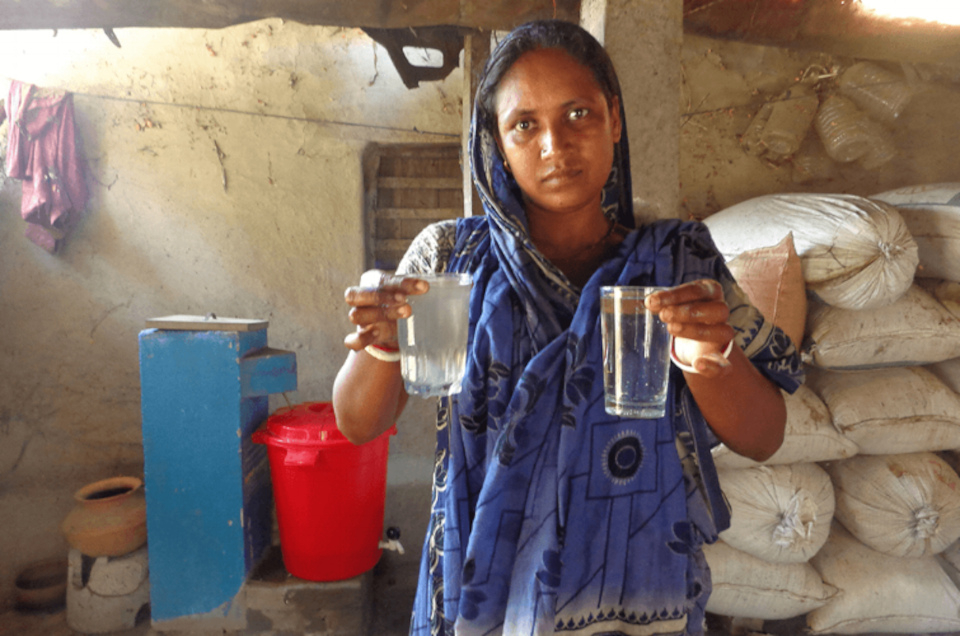
Drinking water from a biosand filter. Photograph from: https://wiki.lowtechlab.org/wiki/Water_-_Biosand_Filter#
15.01 The imperative water treatment for evaporative cooling systems
"Effective water treatment works to control scale, corrosion, and microbiological growth within an evaporative cooling system. It also helps to ensure heat transfer efficiency and extend the service life of the equipment."
"When an evaporative cooling system rejects heat to the atmosphere, only pure water is evaporated. As this occurs, the dissolved ions—naturally occurring in the makeup water source—are left behind. Without proper water treatment, the dissolved ion concentration increases as evaporation continues and, at some point, will reach saturation of the ions, which can lead to scale. The most common form of scale is calcium carbonate. Preventing scale via water treatment impacts the efficiency of heat transfer, thereby reducing energy consumption of the entire system. [...] "Microbiological growth in evaporative systems can lead to accelerated corrosion rates, heat transfer deficiencies due to biofilm, as well as human health related concerns. There are a variety of reasons why one system may experience higher biological activity than another. Tower location, nearby construction or farming operations, the makeup water source, and more can all lead to an increased level of bacteria in the water."
Excerpt from the website of EVAPCO, Westminster, Maryland, United States: https://www.evapco.com/faq/answer/water-treatment-evaporative-cooling-system

The original location where the so-called 'sarcophagus' of the Great Pyramid of Giza was operated as a biosand filter, in what is today the electrical room, situated between the antechamber and the opening to the Grand Gallery. If you are looking for a hidden chamber in the Pyramid, there is one right, because nobody ever talk about it.

See how the northern shaft of the King’s chamber is turning around the filter’s position, so that water could have been transferred from the shaft to the filter. Original drawing of the entire King's chamber complex in the Great Pyramid of Giza, by Franck Monnier: https://en.wikipedia.org/wiki/Great_Pyramid_of_Giza#/media/File:Kheops-chambre-roi.jpg
15.02 The traces of the original location of the sarcophagus
On the above drawing from Franck Monnier, we can very easily see where the biosand filter sarcophagus was set during the operation period of the Great Pyramid of Giza. Please note the intensive digging that have been made around the sarcophagus water supply shaft, probably because something technologically very important needed to be retrieved by ancient Egyptian themselves after the shutdown procedure of the Pyramid (most probably it was a compression valve supplying water to the filter, see next Chapter about active Satis and inactive Anuket, the two goddesses of the Elephantine triad).
Of course, contrary to what are claiming egyptologists, the entire digging that has been made around the initial position of the sarcophagus and controlling valve as well, has been made by ancient Egyptians themselves: in order to get the controlling valve out of the Pyramid (it was an industrial secret all right, no question they wanted it back), they first had to get the biosand filter out of the way. So they uprooted the filter and put it in the only location they could: the King's chamber. Probably before they could have physically moved the filter, they would have had to get all the water and the sand out of the box.

Electrical room of the Great Pyramid, by Corinne E: https://www.tripadvisor.fr/Profile/157corinnee/Review/934152414
15.03 The original operating location of the uprooted sarcophagus
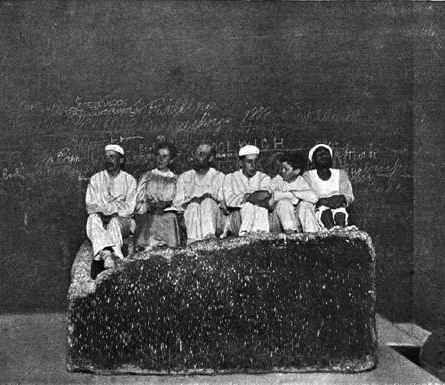
The granite 'sarcophagus' found in the King's chamber of the Great Pyramid of Giza, for many reasons couldn't have been designed for the mummy of pharaoh Khufu, the most worshiped and powerful man known of ancient Egyptians: there is absolutely no sign, decoration or hieroglyph nowhere on the object, or anywhere else in the King's chamber or in the entire Pyramid, if we don't consider the quarry marks found in the 'relieving' chambers.
Plus, the granite box has been meticulously hammered down, on all its edges. That work alone, would have taken maybe 30 minutes or a full hour for one single person; and for what other reason than because this granite box was simply not operated in the King's chamber, where it had been found. All the damage on the edges of the 'sarcophagus' can be explained when you consider that it had to be taken out from somewhere where it had been neatly installed originally. The sarcophagus has literally been uprooted and taken out of its original place with force.

[left] Old photograph taken from the top of the Grand Gallery in the Great Pyramid showing the ‘big-step’: "Great Pyramid Passages, Volume 1, by John and Morton Edgar, 1910" : Plate LXIV, page 166: https://archive.org/details/GreatPyramidPassagesVol11910Edition/page/n247/mode/1up [right] More recent photograph taken from the very top of the Grand Gallery in the Great Pyramid of Giza, looking south and showing the entry to the King’s chamber and antechamber. Photo by Jon Bodsworth, on wikipedia

The strange trajectory of the northern shaft of the King's chamber in the Great Pyramid of Giza is explained by the necessity that Egyptian builders had to connect the shaft with the biosand filter. Original images thanks to the Bibliothèque nationale de France. "Histoire de l'art égyptien d'après les monuments, depuis les temps les plus reculés jusqu'à la domination romaine" 1858-1879, by Émile Prisse d'Avennes (1807-1879). © Bibliothèque nationale de France, département Réserve des livres rares: https://passerelles.essentiels.bnf.fr/fr/image/4aa033bd-f65c-4c5c-8a45-cede4d3d45c7-coupe-galeries-et-salles-la-pyramide-kheops
15.04 The strange trajectory of the northern King's chamber shaft
The first thing to note is that if there are two shafts of the King's chamber, there only is the northern shaft with a very particular trajectory; and of course it can only be explained if there was something that needed to be connected with the northern shaft in or around the little room that is today used as the electrical room of the Great Pyramid. In short, this curious and bent trajectory is only because it was designed to come as close as possible to the sarcophagus, so that it would be connected with it through the valve system. In this area, everything was built around the sarcophagus and obviously there was something in the way of a hypothetical copy of the southern shaft.
The second part is a little tricky to understand, because the above drawing is in two dimensions only. What one need to mentally add to this draw is the height data: the shaft is going up from the King's chamber to the exterior of the pyramid.

To be able to pull the biosand filter of the Great Pyramid of Giza out of its original operating location in what is today the electrical room, the northern wall had first to be partially broken out so that the opening could be widened. Original photograph by Corinne E: https://www.tripadvisor.fr/Profile/157corinnee/Review/934152414
15.05 The uprooting of the biosand filter: the widening of the electrical room's entry
When you look at the above photograph of the entry of the electrical room of the Great Pyramid, there is something striking: the northern side had been considerably widened (red arrows), when the southern side is still intact. So, what ancient Egyptians did when it was time to get the filter out of the way to retrieve the valuable piece of technology that was the compression valve, they probably first took all the water and sand out of the filter (maybe the big broken piece of the 'sarcophagus' has been made for that reason), then they broke part of the northern side wall of that little filtration room and they pulled the filter out towards the entry of the Grand Gallery. Only then, they could have push the filter to its present location inside the King's chamber.

On the above image, you’ll notice that the part of the electrical room’s northern wall that has been broken out, isn’t represented at all as it should be, with the missing broken part; but instead and just like many times, egyptologists had completely idealized the structures they’ve found rather than describing them accurately (you can see for example the ‘forgotten’ limestone kiln of the Red Pyramid, or the ‘forgotten’ sand filter of the Bent Pyramid). [original image from the BNF] © Bibliothèque nationale de France: https://passerelles.essentiels.bnf.fr/fr/image/4aa033bd-f65c-4c5c-8a45-cede4d3d45c7-coupe-galeries-et-salles-la-pyramide-kheops
15.06 The well of the King's chamber and the biofilm of the biosand filtration
It is possible that the well inside the King's chamber, could validate the idea that the sarcophagus was a biosand filter, with a living biofilm of microorganisms on its surface, because that well would have been a perfect water reserve to secure the biofilm even when the chamber was empty. In biosand filters, it is crucial that the biolayer stays under water all the time. If the upper layers of the filter get dry, the biolayer dyes and the filter will need about 30 days to get a functional biolayer back, starting when water is coming back into these upper layers.
Also, there is another thing that absolutely needs to be observed: before getting to the filter with a curb, the northernshaft appears actually pretty straight, and if you extend this straight trajectory you get directly to that well. So, what I think happened, is that the builders wanted to get the filter going as soon as possible, so for a short period of time when the chamber was constructed, the shaft first lead to the well, and from that well, the filter could have been fed. But this is just hypothetical.

"Modeling Improved Performance of Reduced-Height Biosand Water Filter Designs" by James A. Phillips and Samuel J. Smidt, and published on MDPI: https://www.mdpi.com/2073-4441/12/5/1337
15.07 The extreme diversity of biosand filter designs
Until now, I've used many times images of biosand filters that every one can find in family homes in some parts of the world where it is hard to get both drinking water and electricity, but the fact is biosand filters actually come in very different sizes and very different shapes; and of course there is one model of a high capacity biosand filter that looks exactly like the 'sarcophagus' of the Great Pyramid: a very large box, but with a height pretty low.
15.08 The biosand filter 'sarcophagus' of the Great Pyramid of Giza could have produced exactly 201.96 liters of filtered water every 15 minutes
I've suggested the hypothesis that a full cycle of the operating Grand Gallery was about 15 minutes or so (it isn't based on anything else than just guess, but it seems about right), and that it was about 200 liters of pressurized water that would have been ejected from the inclined well towards the flash-evaporative cooling passage. It just sounded right, but I didn't check one thing: was the biosand filter sarcophagus able to supply that amount of water?
I'm not an engineer, so this whole 'practical' thing about numbers is clearly not my cup of tea, even if it was both crucial for the operation of the Great Pyramid and very easy basic science, because the only variable that determines the capacity of a biosand filter to produce potable water, or theoretical flow, is its internal surface:
With an internal surface area of 1.98 m x 0.68 m = 1.3464 m², and a theoretical flow rate of 600 liters/hour/square meter (according to ACF data, below), the biosand filter of the Great Pyramid of Giza would have been able to supply 807.84 liters of filtered water every hour. And that is 201.96 liters of potable water with very high microbiological stability, every 15 minutes. But, be careful: it doesn't mean this is the proof that the operating cycle of the Great Pyramid was about 200 liters of water every 15 minutes or so, what it says is that it was without any doubt I can see, 'exactly' 807.84 liters every hour; and that's a fact.
"The internal dimensions [of Khufu's Sarcophagus] are roughly 198 cm (6.50 ft) by 68 cm (2.23 feet), the external 228 cm (7.48 ft) by 98 cm (3.22 ft), with a height of 105 cm (3.44 ft)." https://en.wikipedia.org/wiki/Great_Pyramid_of_Giza
"The biosand filter has been designed to allow for a filter loading rate (flow rate per square meter of filter area) which has proven to be effective in laboratory and field tests. This filter loading rate has been determined to be not more than 600 liters/hour/square meter." From ACF, a Non-Governmental Organisation (NGO). It can also be called Action Contre la Faim (ACF) which is a French phrase meaning Action Against Hunger. ACF began in France in 1979 and currently, it operates in 40 countries worldwide": source ACF
[illustration] The coffer of the Great Pyramid of Khufu: "Great Pyramid Passages" Volume 1, Plate CXXV page 250, by John and Morton Edgar in 1910: https://archive.org/details/GreatPyramidPassagesVol11910Edition/page/n259/mode/1up
Production of drinking water by biosand filtration: https://wiki.lowtechlab.org/wiki/Water_-_Biosand_Filter#
Diagram of the Great Pyramid of Giza in operation for flash-evaporative cold production (hypothetically for chemical manufacturing cooling of pure sodium carbonate 'natron', the salt used for the mummification of pharaohs). When in operation, the elevation of the Great Pyramid was not finished, and it is only after the shutdown procedure and the draining of the inclined well, that the three granite plugs finally ended up in their actual positions.

"Ram Pokherai drinks clean water from his family's biosand filter. Clean water helps children stay healthy, which means they are less likely to need time away from school, so their education improves. Providing clean water has important knock-on effects." Courtesy of Editorial, Humanitarian & Travel Photographer Gavin Gough, in partnership with the CAWST*: https://www.gavingough.com/clean-water-in-rural-nepal
*The Centre for Affordable Water and Sanitation Technology (CAWST) is a Canadian NGO addressing the need for safe drinking water and sanitation. This assignment illustrates the process of building and using biosand filters in a rural community.

Functioning of a biosand filter for drinking water: https://www.cawst.org/services/expertise/biosand-filter/more-information
15.09 What is a biosand filter and how does it work?
"A biosand filter (BSF) is an adaptation of the traditional slow sand filter, which has been (officially) used for community drinking water treatment for 200 years. The biosand filter is smaller (about 1 metre tall and 0.3 m wide on each side) and adapted so that it does not flow continuously, making it suitable for use in people’s homes. The filter container can be made of concrete or plastic. It is filled with layers of specially selected and prepared sand and gravel. The sand removes pathogens and suspended solids from contaminated drinking water. A biological community of bacteria and other micro-organisms grows in the top 2 cm of sand. This is called the biolayer. The micro-organisms in the biolayer eat many of the pathogens in the water, improving the water treatment. Pathogens: micro-organisms in water that make us sick. Suspended Solids: dirt and other small pieces in the water (may also be called “turbidity”)" Source: https://www.cawst.org/services/expertise/biosand-filter/more-information

“A critical overview of household slow sand filters for water treatment”, in Water Research, ScienceDirect: https://www.sciencedirect.com/science/article/abs/pii/S0043135421010642



© 2021-2025 Copyright milleetunetasses.com. All rights reserved.
