THE PYRAMIDS of the COLD • Chapter 04 The Dendera Light is a technical manual for flash-evaporative cooling: there is no bulb, but a magical fog of microdroplets of water
Publié par Bruno Coursol dans The Pyramids of the Cold Le
21/09/2025 à 06:44
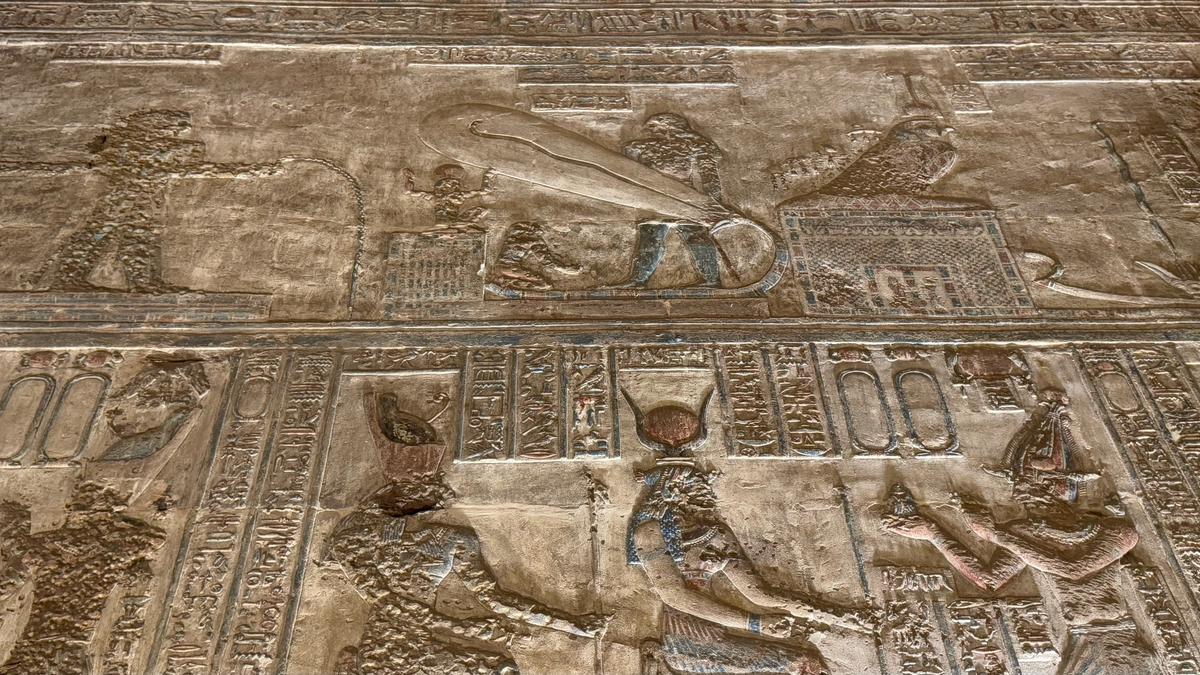
What comes to mind right away when you try to decipher what could really be the famous Dendera light, is to imagine something solid, just like a light bulb; but its true meaning has nothing to do with solid: the Dendera light is about a fog of tiny little droplets of water; it’s about the fog of microdroplets that if created into dry air produces what is known as flash-evaporative cold. This is science and this is magic, all at the same time, and everything there is to know about how it was made, is actually included in the relief. In short, ancient Egyptians possessed advanced scientific and engineering knowledge, which they encoded and glorified within their religious iconography to legitimize their authority. The Dendera Light, in this view, is a didactic representation of a scientific phenomenon rather than a purely mythological or electrical one. Photograph by Kairoinfo4U: https://www.flickr.com/photos/manna4u/14525094039/in/photostream/
THE PYRAMIDS of the COLD • Study written by French researcher Bruno COURSOL (January 2021 to September 2025)
Section A • The flash-evaporative cooling process and the so-called horizontal passage
The "Pyramids of the Cold" study reveals how ancient Egyptians used flash-evaporative cooling, which is nothing other than pure basic thermodynamics, in the Great Pyramid of Giza to facilitate pre-industrial, state-sponsored chemical manufacturing, such as the production of sodium carbonate (the purest form of natron used for the mummification of pharaohs). By encoding this industrial process into religious iconography, as in the reliefs known as the "Dendera Light" not located as is systematically said in the temple of Hathor, but rather in what were in the time of King Khufu, the builder of the Great Pyramid, most certainly the underground crypts of the temple of Atum at Dendera, the priesthood ensured the preservation of technical data while maintaining a "religious veneer" for the uninitiated masses. This glorification of flash-evaporative cooling explains why Dendera was known as the "Land of Atum," a deity described as the one "who cooled down the air and dried out the land," which is a literal description of the effects of evaporation of water. In short, the Dendera Light is a didactic technical manual for flash-evaporative cooling, encoded in religious mythology and iconography, Atum being nothing other than the personification and deification of that natural process which is the evaporation of water; and as it is also a spontaneous process, Atum was known to be a self-created god.
Chapter 04 • The Dendera Light is the glorification of the creation of a fog of microdroplets of water
In summary: the ancient Egyptians were not "primitive" but were a pre-industrial civilization that chose to hide their scientific knowledge behind a "religious veneer", and the Dendera Light bulbs are a perfect illustration of this glorifying process. The subterranean crypts at Dendera were not merely storage rooms for statues; they were secure, restricted-access archives where the elite priesthood preserved the technical blueprints of their state-sponsored industrial achievements. By turning these processes into gods and myths, they ensured that the knowledge remained "sacred" and protected from the uninitiated, while simultaneously glorifying the pharaoh's ability to control the fundamental laws of nature. According to mainstream egyptologists, the Dendera Light carvings are primarily mythological representations; however, in this chapter of "The Pyramids of the Cold," I will explain how the Dendera Light only is a sophisticated illustration of the flash-evaporative cooling process, the one used within the structure of the Great Pyramid’s so-called “horizontal passage”, a mysterious "passage" that starts with thermal expansion joints, presents a ramp of 32 meters at 0.30% slope (the same slope as an aqueduct), and which was discovered completely covered in salt encrustation before it was destroyed by Zahi Hawass in 1998 at the time when egyptologists lost the monopoly on the Egyptological narrative when the first blogs began to be created on the internet, and it therefore became urgent to get rid of this tartar, the signature of evaporative cold. In short, not only ancient Egyptians possessed advanced scientific and engineering knowledge, but they also encoded and glorified this knowledge within their religious iconography: the Dendera Light represents the pinnacle of Egyptian "Sacred Science." Whether one views it through the lens of traditional mythology or as an encoded technical manual for flash-evaporative cooling, it is clear that the Egyptians did not distinguish between the physical and the metaphysical. The reliefs serve as a "layered" artifact: a religious story for the masses and a sophisticated record of natural laws for the initiated priesthood.
The whole layout of the Great Pyramid of Giza was to create flash-evaporative cold through the production of a fog of microdroplets of liquid water in the so-called horizontal passage, and of course Egyptians did want to glorify this accomplishment. We'll see that what is known today as the Dendera light, or Dendera lightbulb, of course has nothing to do with electricity or a light bulb; it only is the exact illustration of the fog of microdroplets that was produced inside the horizontal passage of the Great Pyramid.
In other words, the Dendera Light is only the representation of how was made the cold: by creating a fog, a cloud, a mist of microdroplets of liquid water, and that is why Dendera was known as "the Land of Atum", the god "Who cooled down the air and dried out the land". Put another way, Atum is nothing other than the glorification that the ancient Egyptians made of the process of water evaporation: it is evaporation of water that dries out the land, and it is evaporation of water which is responsible for creating cold through what is known as "evaporative cooling".
We'll see that Egyptians didn't only want to glorify their scientific and technological accomplishments: they also wanted to explain things; so they explained where that fog was coming from, how it was made the same way a snake is spitting its venom, and they explained that the fog was indeed about creating cold by giving to the characters holding the Dendera light, a double outline: this double outline on the whole body of the ones holding, or creating the fog is only because cold gives you goose bumps.
What's truly surprising about the way egyptologists have approached the study of ancient Egypt, is realizing that they had all the right answers from the start, but chose to sweep them under the rug to keep rehashing the same old 19th-century stories: we'll see that the idea that the Dendera light is associated with some mysterious form of magical energy in liquid form is in fact quite common knowledge.
In short, there isn’t any Dendera light, because there is only a Dendera fog: the light bulb is only made of water.
How to Draw A Cloud – A Step by Step Guide]: https://iheartcraftythings.com/cloud-drawing.html
Hathor Temple, where the Dendera light reliefs are located and hidden underground. Dendera Temple Complex in Qena, Egypt. Photograph by Hamerani: https://commons.wikimedia.org/wiki/File:Temple_of_Hathor_at_Dendera_%282%29.jpg

04.01 About the secrecy of the subterranean crypts
The physical location of the Dendera Light is essential for a comprehensive understanding. The reliefs are located in Crypt No. 4, a narrow, hidden chamber within the massive walls of the temple. While the Temple of Hathor is primarily sandstone, the crypts are lined with high-quality limestone. This allowed for much finer, more detailed carving, suggesting that the information contained within these specific reliefs was of the highest sacred or technical importance. These crypts were not open to the public. They were accessible only to high-ranking priests. This supports the idea that the reliefs contain secret knowledge linked to a hidden technological process used by the elite to maintain power. Why would there have been a need to hide what should ultimately be known to all if the Dendera Light reliefs were merely simple religious representations?
The Dendera Light represents a multi-layered symbolic system. To the uninitiated, it was a story of a god being born from a flower. To the initiated priests, it was a sophisticated encoding of the laws of nature, specifically the creation of a mist of microdroplets of water to create flash-evaporative cold. The "Pyramids of the Cold" study reveals that the Egyptians did not separate "science" from "religion"; rather, they glorified their engineering achievements by turning them into deities, ensuring the preservation of technical data through the medium of sacred art.
While “The Pyramids of the Cold” breathes new life into a whole facet of ancient Egyptian culture, the study doesn't truly challenge the official narrative of Egyptian religion. Instead, it reveals the mechanism that allowed the ancient Egyptians to both conceal and glorify all their scientific and technological knowledge within that very religion. Just as the Egyptians used the anatomical, physiological, and behavioral characteristics of the animals around them to illustrate, allegorically and metaphorically, everything that needed to be conveyed in their religion, they also elevated these representations to the status of deities. It's a bit like the famous iceberg metaphor: hidden beneath a kind of religious veneer, the ancient Egyptians, on behalf of the pharaohs, concealed a wealth of scientific and technological information that only the initiated could truly comprehend. In other words, the most important aspect of ancient Egyptian civilization is hidden, but perfectly understandable once one has grasped the basic principle that enabled its development. [Draw of the Great Pyramid of Khufu], showing the flash-evaporative cooling conduct, by Manly Palmer Hall: https://commons.wikimedia.org/wiki/File:The_Secret_Teaching_of_All_Ages_-_Chapter_6_-_Pyramid.jpg

04.02 About the academic explanation of the Dendera Light
The problem with the official and academic version that attempts to explain the extreme complexity of certain depictions of the Dendera Lights is that it never mentions the kind of pipe connected on one end to the lotus flower, and on the other to a structure with perfectly regular, rectilinear edges forming a perfect rectangle. Who mentions this pipe in the official version? Who mentions this rectangular structure?
And who mentions the double outline that traces the silhouette of the figure holding the Dendera Light? Who (really) mentions the mysterious presence of the Djed Pillar? Egyptologists, in reality, can only partially read hieroglyphs, and they are completely lost when it comes to the Dendera Lights. Of course, they try to grasp at straws as best they can, but an eight-year-old could confidently say that the Dendera Lights have something to do with science and technology. In this sense, proponents of the light bulb theory are closer to the truth than egyptologists. But of course, both their versions are wrong.
It is only after understanding that the ancient Egyptians had mastered the production of cold through flash evaporation in the so-called horizontal passage of the Great Pyramid (a horizontal passage that is actually anything but horizontal, since it has a 0.3% slope over the 32 meters of its terminal section leading to the Queen's Chamber, the chamber where the cold was stored), that the analysis and deciphering of the Dendera lights takes on its full meaning: these magnificent reliefs are nothing less than remarkable representations, part religious, part scientific, of the creation of this cold through the production of a cloud, a mist of microdroplets of water.
Operating diagram of the Great Pyramid, showing the flash-evaporative cooling tunnel where cold was created. The Dendera light is actually a very accurate depiction made by the ancient Egyptians of the fog of microdroplets of water which was created inside that passage only to transform into vapor, thus creating the flash-evaporative cold. One way of describing this process metaphorically, is by using a snake spitting out its venom; this is why there is always a snake inside the representations of the Dendera light. If Osiris was supposed to preside over the weighing of the hearts of the deceased, it was because Osiris was merely the glorification of a weight, that of the impactor of the Great Pyramid.
“The Weighing of the Heart, also known as the Judgment of Osiris, was a significant event in ancient Egyptian mythology and beliefs regarding the afterlife.” https://egypt-museum.com/the-weighing-of-the-heart-court-of-osiris/
04.03 The Great Pyramid was built to produce flash-evaporative cold, and the Dendera Light is all about how it was made: the reliefs are a technical manual encoded in religious iconography
The "Pyramids of the Cold" describes how the Great Pyramid of Khufu was designed and operated as a sophisticated flash-evaporative cooling system, capable of producing significant cold temperatures within its Queen's Chamber. This study challenges conventional egyptological interpretations of the pyramid's function, suggesting it was not merely a tomb but a complex industrial facility for chemical manufacturing, specifically the production of natron (sodium carbonate) and sodium bicarbonate. The core of the "Pyramids of the Cold" is built upon several key observations and interpretations, and in particular the flash-evaporative cooling process, which is a highly efficient method of cooling. Unlike simple evaporative cooling (like a damp cloth), flash evaporation involves transforming a fog of microdroplets of liquid water into vapor. This phase transition absorbs a significant amount of heat from the surrounding air, leading to a substantial drop in temperature. Modern evaporative coolers operate on a similar principle, converting liquid water into vapor using the thermal energy in the air to lower its temperature.
Consequently, the findings of "The Pyramids of the Cold" redefines the "Pyramid Age" not as a purely religious era, but as a period of significant technological peak where science and religion were inextricably linked.
The reliefs of the Dendera Light are a technical manual for flash-evaporative cooling. This process relies on the physics of phase transition, where liquid water absorbs heat from the surrounding air to transform into vapor. [illustration] The basic principle of flash-evaporative cooling: https://microcool.com/equipment/industrial-fogging-technology/
To understand the Dendera Light in greater detail, we must analyze the specific components of the reliefs through the lenses of both traditional Egyptology and the flash-evaporative cooling process that was achieved within the Great Pyramid of Khufu. This requires a step-by-step breakdown of the iconography and the physical mechanics of the cooling technology. According to mainstream egyptologists, the reliefs in the subterranean crypts of the Temple of Hathor depict the "First Time" (Zep Tepi), or the creation of the universe, but the "Pyramids of the Cold" study provides a radical alternative, demonstrating the reliefs are a technical manual for flash-evaporative cooling, a process which relies on the physics of phase transition, where liquid water absorbs heat from the surrounding air to transform into vapor. [Vertical section, looking West, of the Great Pyramid of Khufu, in the plane of its passages, showing the so-called horizontal passage where the Dendera light was produced to create flash-evaporative cold].
04.04 If ancient Egyptians themselves associated the Dendera light with some sort of 'protective magical energy in liquid form', it only is because this light bulb actually is the evaporative cooling fog itself
About the widespread theory that the Dendera light bulbs are nothing but real electric bulbs, not only can we question their size (the "light bulbs" of Dendera are about 2 meters long, while a modern electrical bulb is only about ten centimeters), but we can also wonder how that theory that the Dendera lights could be representations of real electric bulbs could have been so widely circulated and supported when the Egyptians themselves used to associate these "bulbs" with “some sort of magical energy in liquid form”: where is the "liquid" in an electric bulb? Why did everyone seem to prefer ignoring this crucial information about the Dendera light bulbs being described as some sort of "magical energy in liquid form that all gods and pharaohs possess" ?
What's truly surprising about the way egyptologists have approached the study of ancient Egypt is realizing that they had all the right answers from the start, but chose to sweep them under the rug to keep rehashing the same old 19th-century stories: the idea that the Dendera light bulbs are associated with some mysterious form of magical energy in liquid form is quite common knowledge:
[About the snake inside the Dendera Light Bulb] "The field surrounding Ra’s snake form is referred to in ancient Egyptian literature as protective magical energy in liquid form that all gods and pharaohs possess (Faulkner 1970*)." https://ahotcupofjoe.net/2016/11/dendera-light-bulb-and-bagdad-battery-nonsense/
*I'm not sure, but the excerpt might be from "The ancient Egyptian book of the dead / translated by Raymond O. Faulkner ; edited by Carol Andrews, 1972."
The Dendera light is the glorification of how was created the fog of microdroplets that produced flash-evaporative cold inside the so-called horizontal passage of the Great Pyramid of Giza. The cold that resulted of the water evaporation was then stored in the Queen's chamber, the only chamber positioned 'at the center of the Pyramid'. Raw elevation data of the collection ramp designed to redirect unevaporated water to the basin of the Queen's chamber, in chapter 03
04.05 The 64 feet of the so-called "horizontal passage" which needed to be protected from cold
What “The Pyramids of the Cold” reveals is that Egyptians didn't separate science from religion. Instead, they glorified their engineering achievements by turning them into gods. Consequently, the Dendera Light is thus a "layered" artifact: to the uninitiated, it was a beautiful myth of the sun's birth. To the initiated elite, it was a sophisticated blueprint of the laws of thermodynamics and chemical engineering that powered the Egyptian state's industrial capabilities.
Egyptians mastered flash-evaporative cold, and they were undoubtedly able to reach very low temperatures, probably around -10° Celsius (14° Fahrenheit) due to system pressurization thanks to the Djed caisson. And even though Zahi Hawass had the salt deposits that accumulated during the pressurization and operation cycles of the Great Pyramid removed, the one-centimeter-wide expansion joints, filled with flexible materials such as resin or tar, are still very much present today, and perhaps these natural materials also recorded these low temperatures in their own way.
In any case, one piece of information could make all the difference in the coming years, when the first computer models or physical reconstructions attempt to determine the system's effectiveness: the Egyptians needed to protect the beginning of the horizontal passage over a distance of exactly 64 feet. These 64 feet are therefore essential data for determining, with considerable precision, the minimum temperature to which the entire system was exposed.
The beautiful and perfect metaphor of the snake spitting out its venom: could the Egyptians have been more explicit and educative to explain what the Dendera light is really all about, and how it was produced? Please notice on the first image that what seems to be important here isn't the snake, but the spat venom of the snake. This particular relief of the Dendera light is perfectly describing how was produced the fog of microdroplets of sprayed water, and they explain on the left side of the relief, what they've depicted on its right side. This is very first basic science class to me. Dendera Light drawing from the New York Public Library (Digital Collections). Author: Auguste Mariette, 1821-1881: https://digitalcollections.nypl.org/items/510d47e2-96c4-a3d9-e040-e00a18064a99
04.06 The snake in the Dendera light is a spitting snake and the metaphor is about how it is spraying its venom
That drawing of the Dendera Light, is absolutely outstanding, because it is organized the same way we do today in every single science book: the theoretical part on one side and the practical part on the other side. It really is first basic science class.
On the left side of the drawing, we can see that the key element is the spat venom of the snake and not the snake by itself: that represents the sprayed water; and on the right side we can see the practical application of that concept inside the horizontal passage of the Great Pyramid: from the inclined well (the ascending passage), is the water pipe going to the fog nozzle and resulting in the creation of the fog of microdroplets. Please note that:
• the angle of the Dendera light bulb is very similar to the angle of the typical venom spray of a spitting snake
• the shape of the Light bulb is very similar to the shape of the horizontal passage.
Large Capacity Fine Fog Nozzles, from Ikeuchi: https://www.ikeuchi.eu/news/pressure-and-flow-rate-in-spray-nozzles/
Certainly one of the most illustrative ancient Egyptian symbols used as a metaphor is the lotus flower, because Egyptians didn't really care at all about the flower: the flower is just a magnificent metaphoric symbol for what it becomes, and that is the seed head of the plant, that resembles to a shower head. Just like you and me, ancient Egyptians used a shower head when taking a shower or a bath, and yes when you get out of the shower or when you get out of the bath, you smell very nice, and it is why the lotus flower is associated with smell in the first place. But of course, associated with the Dendera light, the flower is represented only because of the seed head of the lotus: a perfect illustration of the fog nozzle that created a spray of microdroplets in the Great Pyramid. Photograph thanks to Kairoinfo4U: https://www.flickr.com/photos/manna4u/14525094039/in/photostream/
04.07 The lotus flower from which is emerging the Dendera light isn't about the flower but the seed head of the lotus that resembles to a shower head: this is the fog nozzle that is creating the fog of microdroplets
I really like this image because it perfectly shows how much the lotus seed head resembles to a shower head, but what it doesn’t show, and what makes the metaphor of the lotus plant absolutely perfect, is that not only the seed head looks like a shower head, but of course the lotus is an aquatic plant; it literally lives into the water and is often called ‘water lily’.
So you have the shower head, and you have the water, all in one single lotus flower. It certainly is one of the most brilliant metaphors used by Egyptians, and probably the reason why it spread so easily through the entire ancient world.
Lotus seed head photograph by Zoom Nature: https://www.zoom-nature.fr/les-trois-vies-du-faux-fruit-du-lotus/
In the Dendera light reliefs, the "bulb" is not solid glass but a cloud of water mist. “How to Properly Water Your Garden with Water Sprayer”. Screenshot from a video by Rustica Gardening: https://www.youtube.com/watch?v=RxOIJ4yE5Os
Text above the snake [left]: “Words spoken by Harsomtus, the great God, who dwells in Dendera, who is in the arms of those at the prow in the Mesketet-night-barge, noble cobra, under whose Khenty-statue is Heh, whose crew carries in holiness [his] perfection, whose Ba caused the Rising [woman] to rise in the sky, whose form is revered by his followers, who comes in solitude, encircled by his Mehen-uraeus, countless of names at the front of Khu-en-sen, the power of Ra in the Land of Atum (Dendera), the father of the Gods, who created that which exists. Gold and metal, height: four palms.” https://en.wikipedia.org/wiki/Dendera_light
Drawing of the Dendera Light by French artist Auguste Mariette, from the New York Public Library (Digital Collections): https://digitalcollections.nypl.org/items/c3b45340-c60b-012f-f72e-58d385a7bc34?canvasIndex=0
04.08 If Dendera was known as "the Land of Atum", and Atum as the One "Who cooled down the air and dried out the land", it only is because Atum is nothing other than the glorification of the evaporation process itself
Here is one of the finest illustrations of all the enigmas and metaphors, both hidden yet right in front of everyone, that are present by the thousands within the religion of ancient Egypt: what is capable of both drying out the land and cooling the air, if not precisely the natural phenomenon of water evaporation? Please read Chapter 2 for a full chapter on Atum.
In summary, Dendera was known as "the Land of Atum," because just like Atum, Dendera and the Dendera Light were intimately linked to the glorification of water evaporation and the use the Egyptians made of this phenomenon.
“Atum separated land from water and basically had to organise everything himself from then on. For a long time, he was the organisation. And he laid good foundations. During his tenure, he cooled down the air and dried out the land, and those who came after can thank him for that.” https://susanllewellyn.wordpress.com/2010/02/05/what-kind-of-god-do-you-think-you-are-atum-1/
[Tapéret stele] that shows the glorification of evaporation of water, that is Atum, while goddess Nut is illustrating and completing the water cycle just above him, because Nut is nothing other than the glorification of evaporated water itself (Nut was known as "the goddess of the sky"). -730 / -745 (XXIIe dynastie thébaine; XXIIIe dynastie) E 52; N 3663 at the Louvre museum [edited from original photograph]: https://collections.louvre.fr/en/ark:/53355/cl010017961
04.09 Because Atum is nothing other than the glorification of the spontaneous process of water evaporation, it was perfectly well known to everyone that Atum was self-created and indeed born directly from water
What's particularly interesting about Atum is that the ancient Egyptians were careful to emphasize that the process of water evaporation was spontaneous and therefore required no assistance whatsoever, which is why Atum is described as "having created himself." Of course, what this means is that all the other Egyptian deities described as "self-created” are probably also glorifications of spontaneous natural processes.
“In the Heliopolitan Cosmogony, Atum was considered to be the first god, having created himself, sitting on a mound (benben) (or identified with the mound itself), and rose from the primordial waters (Nu).” en.wikipedia.org/wiki/Atum
“According to Egyptian myth, before the world was created, the universe consisted of a formless sea of chaotic waters called Nun. In the midst of this vast nothingness arose a great mound of earth known as Ben-Ben. It was upon this mound that the first god, Atum, created himself. Atum realized that he was alone in the nothingness and so he created two children, Shu and Tefnut. Shu was the god of air who brought the breath of life to the world. Tefnut was the goddess of moisture who also represented order. In some versions of the myth, Atum created his children by mating with his own shadow. In other versions, his children were born from his spit or semen.” https://www.ebsco.com/research-starters/religion-and-philosophy/atum-deity
Representation of Geb, Shu and Nut. Geb is laying on the ground, because he is all about water on the ground (that is liquid water), Nut is arched above him (with boats on her body, because she is all about water in the air, and that is humidity), and god of dry air Shu is suporting that humidity in the air. Papyrus mythologique de Tanytamon, Egyptien 172. Bibliothèque nationale de France, département des manuscrits: https://gallica.bnf.fr/ark:/12148/btv1b8304598h
04.10 Nut and the water cycle: if the Dendera Light carvings represent "the womb of Nut", it is because Nut isn’t "the goddess of the sky" but "the goddess in the sky". In other words, Nut is evaporated water itself
If there is one perfect illustration of the method the ancient Egyptians constantly used to glorify and personify all sorts of ideas, concepts, tools, equipment, or technological processes in the writing of what we now call "ancient Egyptian religion," it is undoubtedly the Papyrus of Tanytamon: in this magnificent representation of Shu, Geb, and Nut, water is never depicted as such, and yet water is absolutely everywhere, because the goddess Nut is nothing other than the glorification of water. Or rather, a certain form of water: if we see boats "resting" on the body of the goddess Nut, it is because Nut is precisely water. Nut is therefore not the goddess of the sky, as egyptologists claim, but rather the very specific form of water that is in the sky: Nut is humidity in the air.
This is why Nut is depicted in the characteristic arched form of the goddess: she simply completes the water cycle. We can therefore understand why Shu is represented as if he were carrying Nut: it is indeed the air (Shu is the god of dry air) that carries the moisture of the air. And if Nut completes the water cycle, it is also because the other part of the water, that which is not in the air, is found on the ground: in other words, Geb, who is depicted lying on the ground, is not at all the god of the earth, but the god of the water that is on the ground. This explains the fisherman casting his net, depicted on the same plane as Geb. In other words, the central element of the Tanytamon papyrus is nothing other than the glorification of the water cycle.
About the Dendera light: “According to egyptologists, the bulb-like structure represents the womb of Nut, the goddess of the sky, which is also a common depiction for the night. Thus, the relief might show the rising sun making its way through the night.” https://www.atlasobscura.com/places/dendera-light
[Stela of Tjanetiset, representing Nut pouring and showing water 'in the air', because she is that water 'in the air' herself (that is humidity)] “The Mistress of the House, Chantress of Amun, Tatiaset, was a daughter of Siah. She was married to a Scribe of the House of the Divine votaress of Amun, Djedbastet, son of Merenkhonsu. One side of her stela shows the deceased being led by Anubis toward the seated statue of Ra-Harakhty. The other has the deceased on the left, facing the right. She and her husband, each seated on a chair, receive water from Nut in the tree. The goddess, as was common in this period, is shown in a frontal view.”: https://www.metmuseum.org/art/collection/search/550807
God of dry air Shu (painted blue, with a feather above the head), and goddess of moisture Tefnut. Combined together, they create evaporative cold. [Stèle d'Ousirour] at the Louvre: https://collections.louvre.fr/ark:/53355/cl010014444
04.11 Nut and Tefnut "She Who produces water" are two complementary representations of humidity: the water that has just evaporated is Tefnut, and that same water evaporated while suspended in the air is Nut
The idea that Nut is ultimately just the glorified representation of a certain form of water is also suggested by another goddess, Tefnut, who is known to be indeed linked to the idea of moisture. It should also be noted that 'Tef' in 'Tefnut' literally means 'to spit'. The ancient Egyptians actually scattered numerous clues throughout their religion regarding their obsession with science, and in particular the magical association of dry air (Shu was precisely the god of dry air) with moisture, of which Tefnut was the goddess. Combine dry air and moisture, and you get the very principle of evaporative cooling. Combine Shu with Tefnut, as in the illustration opposite, and you get evaporative cooling.
Considering that Atum is nothing other than the glorification of the process of evaporation, by which water is 'expelled' or 'spit out', then we understand the 'intimate' relationship between Atum and Tefnut: it is indeed Atum (evaporation) that creates Tefnut (the water resulting from evaporation). In reality, according to our current standards, we would say today that Nut and Tefnut actually represent the same thing; but the ancient Egyptians liked to dissect and analyze everything. Thus, when Tefnut was invoked, it was to glorify and magnify the water resulting from the process of evaporation, whereas when Nut was mentioned, it was to emphasize the fact that this evaporated water remained suspended in the dry air. In summary, Nut and Tefnut are just two different but complementary representations of the same physical reality: the humidity of the air (the water present in the air around us).
“Tefnut (Ancient Egyptian: tfn.t; Coptic: ⲧϥⲏⲛⲉ tfēne) is a deity in Ancient Egyptian religion, the feminine counterpart of the air god Shu. Her mythological function is less clear than that of Shu, but egyptologists have suggested she is connected with moisture, based on a passage in the Pyramid Texts in which she produces water, and on parallelism with Shu's connection with dry air.” https://en.wikipedia.org/wiki/Tefnut
“The name Tefnut has no certain etymology but it may be an onomatopoeia of the sound of spitting, as Atum spits her out in some versions of the creation myth. Additionally, her name was written as a mouth spitting in late texts.” https://en.wikipedia.org/wiki/Tefnut
[The venom spat by the snake] The religion of ancient Egypt was not merely a collection of myths but a sophisticated framework for encoding, preserving and glorifying scientific and technological knowledge. The pharaohs, as divine rulers, would have presented such advanced achievements as divine interventions to legitimize their authority. Here, the double outline of the figures holding the Dendera Light is because by creating cold, they are experiencing cold and they simply have goose bumps. Note that the double outline is only present on the side of the figures directly facing the Dendera light, and so really exposed to the cold. Note that the same convention of representing water 'in the air' as previously used by the ancient Egyptians on the Stela of Tjanetiset with Nut is also used here with the venom of the snake: it is the droplets of venom projected into the air. [Dendera Light] drawing from the New York Public Library (Digital Collections). Auguste Mariette: http://digitalcollections.nypl.org/items/510d47e2-96c4-a3d9-e040-e00a18064a99
04.12 The double outline of the characters holding the Dendera Light is because by creating the cold, they are experiencing cold and they simply have goose bumps
This 'double outline' isn't discussed at all by anybody, though it is the most important element of the Dendera reliefs. The fog is made of microdroplets of liquid water and it would evaporate itself, taking the necessary energy from the air. The result is the cooling down of the air. The character is producing ang offering cold, but he is also experiencing cold himself.
04.13 The 'Power of Water' and the 'Bristling Hair' reference in the Book of the Dead of Ani
The idea itself of cold temperatures induced by the association of air and water, is actually present in a chapter of the Egyptian Book of the Dead of Ani: "The Chapter Of Breathing The Air And Of Having Power Over Water in Khert-Neter."
"The Osiris Ani saith: Open to me! Who art thou? Whither goest thou? What is thy name? I am one of you. Who are these with you? The two Merti goddesses (Isis and Nephthys). Thou separatest head from head when [he] entereth the divine Mesqen chamber. He causeth me to set out for the temple of the gods Kem-heru. "Assembler of souls" is the name of my ferry-boat. "Those who make the hair to bristle" is the name of the oars. "Sert" ("Goad") is the name of the hold. "Steering straight in the middle" is the name of the rudder; likewise, [the boat] is a type of my being borne onward in the lake. Let there be given unto me vessels of milk, and cakes, and loaves of bread, and cups of drink, and flesh, in the Temple of Anpu."
Papyrus of Ani, Egyptian Book of the Dead (240 BCE), translated by E.A. Wallis Budge (last third of the page): http://www.ancienttexts.org/library/egyptian/bookodead/book5.htm
Photograph thanks to Kairoinfo4U: https://www.flickr.com/photos/manna4u/14525094039/in/photostream/
On these Dendera Light Bulbs reliefs, it is worth noting that the entire shape of the micro-droplets cooling fog entirely fits in a space that has the exact height of the passage where the process starts on the drawing it is on. Dendera Light drawing from the New York Public Library (Digital Collections). Author : Auguste Mariette, 1821-1881
04.14 The height of the Dendera Light bulbs
On the left drawing, 1 and 1' have the same height. On the right drawing, 2 and 2' have the same height as well. And same thing on the drawing above, with the venom coming out of the snake: the height of the starting passage equals the maximum height of the fog. In other words, the fog of microdroplets was limited by the height of the passage.
It is still unclear to me if that means that 1 and 2, strictly represent the horizontal passage of the Great Pyramid, where the cooling fog was created, or if it also includes the inclined well (the ascending passage) from where the pressurized water was coming from.
Raw elevation data in the so-called horizontal passage of the Great Pyramid of Khufu, in previous chapter 03
04.15 The collection ramp, nearly 32 meters long with a slope of 0.30%, was necessary because not all the water from the fog of microdroplets evaporated: the water that remained in liquid state had to be treated
The very famous Dendera light bulbs are neither purely metaphysical and religious representations, nor electric light bulbs, but the perfect didactic representation of the creation of a cloud of microdroplets that generates the cold created by flash evaporation; however, because during this flash evaporation process, a small portion of the microdroplets of liquid water will not be able to evaporate, a collection ramp had to be put in place to prevent this water from stagnating and hindering the proper functioning of the process (in particular, there are significant risks of microbial growth).
In short, the slope of 0.30% of the so-called horizontal passage of the Great Pyramid of Giza, created a 32 meters collection ramp that would have collected and redirected any liquid water that didn't evaporate toward the basin of the Queen's chamber, the only chamber to be located in the center of the Pyramid.
• Length of the collection ramp: 1307 - 52 = 1255 inches, or 3187.7 cm.
• Elevation loss of the collection ramp: 858.4 - 854.6 = 3.8 inches = 9.65 cm.
• Slope of the collection ramp: 3.8/1255 = 0.30%
A foundational aspect of "The Pyramids of the Cold" is the assertion that ancient Egyptian religion was not merely a collection of myths but a sophisticated framework for encoding, preserving, and glorifying scientific and technological knowledge: the pharaohs, as divine rulers, presented their advanced engineering and scientific achievements as divine interventions or sacred mysteries to legitimize their authority. Therefore, the Dendera Light, while appearing as a religious relief, is simultaneously a deified representation of a complex technological process. Photograph from the Hathor temple, by Kairoinfo4U: https://www.flickr.com/photos/manna4u/14525094039/in/photostream/
Not only are the Dendera Lights not a representation of a solid object, much less that of an electric light bulb, but these objects are obviously not static either: just like the piston-like composite impactor itself, the cloud of microdroplets of liquid water, and by extension the cold cloud that resulted from its flash-evaporation, was itself moving very fast through the so-called horizontal passage of the Great Pyramid of Khufu, as fast as the falcon. [illustration] Detailed relief of Harsomtus as a falcon and a snake, in the subterranean crypt of Hathor temple at the Dendera Temple Complex in Qena. Snapping Fire Dragon, Atlas Obscura User: https://www.atlasobscura.com/places/hathor-temple
04.16 If Harsomtus was known as "Horus who unites the two lands” it is because he is the glorification of flash-evaporation itself: water going to one phase to the other (liquid to vapor) as fast as a falcon... in just a flash
As I have said many times before, the greatest revelation of the "Pyramids of the Cold" is not that the Great Pyramid of Khufu was designed solely to generate extremely low temperatures using the process now known as flash-evaporative cold, but rather that each of the scientific knowledge, tools, and technological equipment used by the ancient Egyptians was personified and glorified as gods and goddesses. Egyptians used to illustrate each of these glorifications by tirelessly using the same method of finding similarities or equivalences within their own environment between the original idea and their religious reflections, and as often as they could, they used animals for these illustrations.
For example, when it was necessary to illustrate the characteristic of speed, ancient Egyptians used the falcon, which represented what could be considered the fastest animal at that time. This is why Horus (the glorification of the Great Pyramid's impactor gliding at full speed inside the central wooden Djed caisson) was primarily depicted as a falcon, but it is also why Harsomtus, usually represented as a serpent within the Dendera lights, could also be depicted as a falcon. Remember that we are talking here about the flash-evaporation process, a principle in which the phase change (from liquid to gas) is almost instantaneous. These two phases are also very likely the origin of the most well-known epithet associated with Harsomtus: "Horus who unites the two lands".
"Harsomtus (also known as Harsomptus and Somtus) was an ancient Egyptian child god with main cult places at Dendera and Edfu. This less-known deity was worshipped from the Old Kingdom period all the way to Graeco-Roman Egypt. Popularity of Harsomtus, along with other child gods, greatly increased in the Graeco-Roman period, with most information coming from that era. The connection with Horus had formed early, and Harsomtus is considered by researchers to be a form of Ra or Horus. His name translates to "Horus who unites the two lands". [...] Due to connection with Horus, Harsomtus can appear with a falcon head.” https://en.wikipedia.org/wiki/Harsomtus
The Dendera light must be analyzed as a sophisticated intersection of ancient Egyptian thermodynamics, religious iconography, and linguistic encoding. While the visual resemblance to a light bulb is the most common entry point for modern observers, the deeper technical and mythological layers reveal a civilization that used sacred art to preserve complex physical observations, specifically the creation of extreme cold through flash-evaporation. In short, the "Pyramids of the Cold" study, reveals the relief is a technical manual for flash-evaporative cooling. This process relies on the physics of phase transition, where liquid water absorbs heat from the surrounding air to transform into vapor, causing a significant drop in temperature. [above image of the venom visual metaphor] the didactic spitting snake, demonstrating how was made the Dendera light, by creating a fog of microdroplets, speeding very fast into the air
Dendera Light relief drawing on the left: please notice that what seems to be important here isn't the snake, but the spat venom of the snake. Also, you can see that the figures holding the snake are showing a double outline, the same way that the character holding (or offering) the Dendera Light does, on the right part of the drawing. The Dendera Light is produced by the snake, or as explained: by the venom of the snake. In short, this particular relief is describing how was produced the fog of microdroplets of sprayed water. Dendera Light drawing from the New York Public Library (Digital Collections). Auguste Mariette: http://digitalcollections.nypl.org/items/510d47e2-96c4-a3d9-e040-e00a18064a99
04.17 A tiny little guy for the tiny little 0.30% slope of the evaporative cooling passage
This relief in the Hathor temple at Dendera, showing the Dendera Light is without any doubt one of the most important source of information that Egyptians had left for us to decipher. I’ve already understood a few things about this relief:
• the Dendera Light is the representation that Egyptians themselves have made of the fog of microdroplets created in the evaporative cooling passage of the Great Pyramid (right side of the relief)
• the two men on the left are only explaining why there is a snake inside the Dendera Light: the snake is here to demonstrate how was produced the fog: just like a spitting snake is creating his own fog of microdroplets of venom
• the double outline that the three big characters are showing is because the cold is given them goose bumps
• the lotus flower is only here as a representation of the fog nozzle, and it isn’t about the flower of the plant, but about the seed head, that resembles exactly to a shower head
But now that I have started to get more information about the 0.3% slope of the so-called horizontal passage, the exact same slope than the one used on Roman aqueducts (see chapter 01), it draw my attention to the little guy on the right, pointing his hands to the feet of the big guy holding the Dendera Light. And suddenly, it struck me! What is this little guy doing in this position becomes suddenly evident.
• first, if this big guy is holding the Dendera Light, it only is because he really is the cooling passage itself, the place where the fog of microdroplets was produced
• then, it means that his feet are about the floor of that passage
• and the real meaning of this little guy becomes crystal clear: by pointing to the feet of the big guy, he is simply pointing to the 0.3% slope of the passage’s floor. The top of the big guy’s feet, with a little slope, is about the slope of the passage’s floor.
04.18 And here comes the salt deposit: the double outline is also about that salt encrustation
This salt deposit thing, is probably the most incredible proof of what really happened in the Great Pyramid, it is the signature of evaporative cooling, even today, so it really is a shame it had all been removed in 1998 by Zahi Hawass. But if the double outline is representing goose bumps on the big guy holding the Dendera Light, then this same double outline is also representing the salt deposit of the cooling passage itself, because that guy also is the cooling passage.
Traditionally, the Dendera light is seen as a complex relief depicting "the god Harsomtus as a snake emerging from a lotus flower", which mainstream archaeology identifies as a creation myth representing the rising sun, for some very mysterious reason; however, advanced scientific analysis demonstrates it is a technical illustration of a "Dendera fog": a mist of microdroplets of water used to create flash-evaporative cold, a process used within the Great Pyramid itself.
04.19 Another example of the didactic approach, or complete obsession, with which the ancient Egyptians glorified their scientific knowledge and technological accomplishments by creating sophisticated mythological symbols, just like the Djed pillar
In the depiction of the Dendera Lights above, you can also see one of the many illustrations of how the ancient Egyptians liked to explain things; one of the fundamental reasons they developed an entire religion around their scientific knowledge and technological prowess was to be able to explain things, they wanted to be didactic.
It is with this idea in mind that we should look at the double representation of the Dendera Light above: both actually represent exactly the same thing. On the left of the image is the creation of the cloud of microdroplets from the central pressure-resistant wooden caisson, shown in cross-section, while on the right side of the image this same caisson is represented in its mythological form, namely the Djed pillar. That is why these two elements are in direct contact with each other: they are the same thing.
Evaporative cooling applications webpage screenshot: AquaFog® from Jaybird Manufacturing Inc (Pennsylvania, USA).
In a perfectly scientific didactic manner, you'll note that the ancient Egyptians have here brilliantly illustrated, in two different ways of the exact same technological scene representing the creation of cold through flash-evaporation of water, the equipment that is the source of the Dendera light, and this is of course what I have called the central wooden Djed pressurization caisson that stood in both the Grand Gallery and the inclined well of the Great Pyramid: drawn in cross-section on the left, and drawn in its metaphorical representation on the right, namely the Djed pillar. In short, the Djed pillar is nothing other than the structure that made it possible to produce the Dendera light, because it produced the compressed air necessary for the flash evaporative cooling process to be effective, cycle after cycle.
04.20 Why the Djed pillar is often represented in a strongly inclined position
Note that, as very often, Egyptians here wished to remind us that because the origin of the Djed pillar was to be inclined according to the abrupt angle of the Grand Gallery and the inclined well, the Djed pillar is here consequently also represented in a strongly inclined manner, which is obviously not the primary characteristic of a so-called “pillar”.
Evaporative cooling applications webpage screenshot: AquaFog® from Jaybird Manufacturing Inc (Pennsylvania, USA).
Operating diagram of the Great Pyramid for flash-evaporative cooling of a Solvay-like process, showing the central role of the pressure-resistant central wooden Djed caisson which was set in both the Grand Gallery and the inclined well. It is from this wooden caisson that all the pressurized air and water that formed the "Dendera Light" came from.
Extremely important image of the Dendera Light, showing that the bulb actually originates directly from the base of the Djed pillar. Original photograph by the Madain Project: https://madainproject.com/dendera_light
04.21 Why the Dendera “light” (pressurized air and water creating the fog of microdroplets) really originates from the Djed pillar (the strongly inclined wooden caisson)
While many examples show the Dendera Lights in direct association with the Djed pillar, egyptologists clearly struggle to interpret and understand this essential link. However, things are different today, as we will see from chapter 32 and following of “The Pyramids of the Cold”: the Djed pillar is nothing other than the ancient Egyptians' glorification of the enormous wooden structure that stood in the Grand Gallery when the Great Pyramid was in operation. This structure included the central wooden Djed caisson (the trunk of the Djed pillar) as well as the transverse structure of the hauling Beetle (the four horizontal sections of the Djed pillar). Always bear in mind that the flash-evaporation cooling system required the production of both pressurized water and pressurized air, and it was the central wooden Djed caisson that ensured this dual pressurization; and that is why we see here, on the photograph by the Madain Project, the Dendera Light bulbs directly connected by a kind of pipe, to the base of the Djed pillar.
04.22 If the Djed pillar was associated with the idea of "enduring" it is because it was the piece of equipment responsible for generating both pressurized air and water: the Djed caisson had to withstand and resist the pressure
“We do not know the exact origin of the Djed pillar, but its hieroglyphic meaning (“enduring” or “stability” and sometimes “column”) is not doubted. There is no apparent connection between the concept of “enduring” and the process of insulating, but even if there was, it is my understanding that the Djed wouldn’t work as an insulator. In a light bulb, the glass bulb itself insulates the filament, and no extra component is required.” https://ancientegyptonline.co.uk/denderahlightbulb/
Operating diagram of the aerial part of the pressure-resistant central wooden Djed caisson of the Great Pyramid of Giza, in which the weighted impactor circulated tirelessly, cycle after cycle. Because all the pressurizing power of that impactor came from its weight, this ballast had become glorified into the very god Osiris. If Osiris was the god of the dead, it is because locked in his wooden "chest", he was himself the dead weight of this impactor (just like described in the Osiris myth). According to egyptologists, the Djed pillar represents the "backbone" of Osiris, and you understand why by simply considering that the central wooden Djed caisson of the Great Pyramid was made of wooden girdles stacked one on top of the other, just like the vertebrae of the spine.
04.23 The "Zep Teti" (the "First Time") is really about that magical moment when water disappears and creates flash-evaporative cold
According to mainstream egyptologists, the reliefs in the subterranean crypts of the temple of Hathor depict the "First Time" (Zep Tepi), or the creation of the universe; but they are mistaken, and see only the tip of the iceberg: beneath the magnificent veneer of pretty little stories from Egyptian mythology lie the true meanings of that mythology.
For the Dendera Light reliefs, it is not the creation of the world that is being discussed, but rather the creation of cold, that magical moment when liquid water transforms into vapor, and thus literally disappears, instantly creating cold. That is what the Zep Teti is really about. The "First Time" is about the creation of the cold.
04.24 The Old Kingdom as a "pre-industrial" civilization
The study of “The Pyramids of the Cold” aims to redefine Egyptology by shifting the academic focus from theology and linguistics to chemical engineering and physics. It posits that the Old Kingdom was a "pre-industrial" civilization that reached a technological peak before going extinct due to the monopolization of knowledge by the elite. This framework explains the presence of high-status chemical products like glass and pure natron as the output of a rigorous, state-sponsored research program rather than accidental discoveries. By integrating the Sabu Disk, the Red Pyramid, and the Great Pyramid into a single industrial workflow, "The Pyramids of the Cold" study offers a cohesive, functional narrative for the most famous monuments on Earth; it explains how the "Pyramid Age" was not a religious era but a "Pre-Industrial Revolution" that eventually collapsed.
Note that, as very often, the Egyptians here wished to remind us that because the origin of the Djed pillar was to be inclined according to the abrupt angle of the Grand Gallery and the inclined well, the Djed pillar is consequently also represented here in a strongly inclined manner, which is obviously not the primary characteristic of a so-called “pillar”. Dendera Light: https://www.facebook.com/photo?fbid=122280637730210986&set=pcb.2676967812638661
Dendera Light relief in an underground crypt of the Temple of Hathor, that was part of the initial foundations dating back to the reign of Khufu. Photograph by Olaf Tausch: https://commons.wikimedia.org/wiki/File:Dendera_Krypta_45.jpg

04.25 The foundations of the Temple of Dendera, hence the subterranean crypts where are located the Dendera Light reliefs, are indeed linked with Khufu
The true significance of finally understanding the extraordinary reliefs of the Dendera Light, which is the glorification of the flash-evaporation process for generating cold, and the fact that this remarkable technological feat was only truly mastered in the Great Pyramid of Khufu, lies in the fact that the Temple of Hathor, where these reliefs are located, is directly linked to Khufu himself.
If it is well known that the existing temple's structure began construction in 54 B.C.E, the late Ptolemaic period, under the reign of Ptolemy Auletes (Wikipedia), what is really interesting is that the underground crypts, where the Dendera Light reliefs are located, and the entire foundation of the Hathor Temple are actually dated to the time of King Khufu.
Undoubtedly, on the site where the Temple of Hathor now stands, there was, during Khufu's reign, what we might today call an "applied physics laboratory," dedicated to producing cold through flash-evaporation, as suggested by Dendera's epithet of being "the Land of Atum", and Atum's epithet of being the god "Who dried out the land and cooled down the air" (see why Atum was the glorification of the water evaporation process, paragraph 04.07).
“The Temple of Hathor, also known as Tentyris, is a remarkable example of ancient Egyptian architecture located in the Dendera Temple Complex in Qena, Egypt. The present structure of the temple dates back to the Ptolemaic Period (305-30 BC) and was completed by the Roman Emperor Tiberius (14-37 AD). However, its foundations are thought to date back at least to the reign of Pharaoh Khufu (d. 2566 BC)”. https://www.facebook.com/AncientEgypt4/posts/marvel-of-ancient-egyptian-architecture-temple-of-hathorthe-temple-of-hathor-als/122134676318270008/
“The Dendera Temple complex, which contains the Temple of Hathor, is one of the best-preserved temples, if not the best-preserved one, in all of Upper Egypt. The whole complex covers some 40,000 square meters and is surrounded by a hefty mud brick wall. The present building dates back to the times of the Ptolemaic dynasty and was completed by the Roman emperor Tiberius, but it rests on the foundations of earlier buildings dating back at least as far as Khufu (known as the Great Pyramid builder Cheops, the second Pharaoh of the 4th dynasty [c. 2613–c. 2494 BC]) but it was the pharaoh Pepi I Meryre who built the temple.” https://www.flickr.com/photos/eliasroviello/30340798587
“Originally, even before recorded history, it is claimed that the mythical "Servants of Horus," a kind of demigod who preceded the human pharaohs, were behind the plans and rituals of Dendera. They are said to have inspired the pharaoh Khufu (4th Dynasty), who supposedly left behind ancient documents, and later Pepi I (6th Dynasty).” Translated from https://fr.wikipedia.org/wiki/Temple_d%27Hathor_(Dend%C3%A9rah)
[illustration] “Stairwell in the Temple of Hathor at Dendera, looking from the crypt toward the landing. On the left side of the landing is the set of stairs leading up to the main floor of the temple. It's a tight squeeze.” Photograph by A. Parrot: https://commons.wikimedia.org/wiki/File:Stairwell_of_the_Dendera_crypt,_leading_up.jpg

04.26 Even before the existence of the Temple of Hathor at Dendera, there was first a Temple of Atum, the god "Who cooled down the air and dried out the land"
Obviously, the very presence of the underground crypts dating back to the reign of Khufu, means that before the current temple became dedicated to Hathor, an earlier temple was indeed built in connection with Atum. In short, the Temple of Hathor was built on the site of a pre-existing Temple of Atum. This realization of the original Temple of Atum also provides a starting point for answering a question I haven't been able to answer until now: why on earth are the Dendera Lights located in a temple dedicated to Hathor, the goddess who allowed the ancient Egyptians to glorify what I've called "the hauling plug," which was installed inside the central wooden Djed caisson of the Great Pyramid. This plug allowed both the two hauling ropes to be lowered into the caisson when empty (the passive phase of their operating cycle), and also to physically connect to the two small mooring bollards of the impactor before beginning the hauling process (the active phase). Of course, it remains to be understood why this change in the temple's allocation was carried out in the first place.
More on Hathor, the goddess known as "Mistress of the counterweight" in Chapter 46 and following chapters.
[On the above images, Hathor isn't on top of a Djed pillar, she is inside the Djed pillar] Cairo Museum, gallery 20. Photograph by Gihane Maamoun: https://www.facebook.com/photo/?fbid=1851812581598238&set=a.622059851240190
Operating diagram of the aerial part of the pressure-resistant central wooden Djed caisson of the Great Pyramid of Giza, showing the crucial role of the Hathor hauling plug which circulated tirelessly inside the Djed caisson, cycle after cycle (in pink). This hauling plug allowed both the two central hauling ropes to be lowered down into the Djed caisson to be reconnected with the more or less-floating impactor (the hauling plug is first a counterweight, and it is the passive phase of the hauling ropes’ operating cycle), and then to physically connect to the two small mooring bollards of the piston-like impactor before beginning the hauling process (that is the active phase of the hauling plug).
04.27 The "Cold Water" Serdab of the Pyramid of Djoser
What is implausible is that egyptologists actually had the possibility of correctly deciphering the Dendera Lights since, without even realizing it, they constantly refer to the link that the ancient Egyptians themselves made between water and cold: the very first of the great pyramids, the Step Pyramid complex of Djoser, was indeed called “the Refreshment of the Gods” and it is known to all for a kind of very peculier small room adjoining the pyramid, called the “Serdab”, which literally means "cold water" (see next Chapter 5).
Egyptologists only ever talk about one thing when discussing ancient Egypt: religion and funerary practices. What they should have done from the beginning is focus on cold, on the cold created by water. Our modern civilization has long since lost interest in this quest for cold, simply because we already know how to reach the lowest possible temperatures. Today, we are only interested in the quest for the highest possible temperatures, and we try to reproduce the temperatures of stars in the very heart of our physics laboratories. Well, the ancient Egyptians of the first four dynasties were at the stage of reproducing the lowest possible temperatures of their time.
Front wall of Djoser's Step Pyramid' Serdab, which was most certainly used as a cooling chamber, with water pipes getting in and out the structure through the two mysterious holes. Photograph by John and Loretta at Seeing the Past: https://www.seeingthepast.com/blog/stepped-pyramid
04.29 Egyptology and the iceberg metaphor
To try and describe what Egyptology still is today, the iceberg metaphor is perhaps the most appropriate: for over 200 years, egyptologists have only been discussing the visible part of this formidable ancient civilization, while its true nature lies hidden beneath.
No, the ancient Egyptians were not simply worshippers of virtually every form of animal life that surrounded them; they simply used these animals like a painter uses different colors to depict reality on a canvas. The Egyptians glorified animals because they used them as mere tools, based on their morphology, their abilities, and their behavior.
It is now everyone's responsibility today to stop repeating the same pretty little stories that were already being told in the 19th century, because today in the 21st century, these pretty little stories have become very mediocre nonsense.
04.30 Complacency and resignation versus the revolution of Artificial Intelligence
Even today, the discipline known as Egyptology can be summed up in two words: complacency and resignation. For over 200 years now, egyptologists have effectively refused to objectively describe ancient Egypt and the extraordinary sophistication of its civilization. Complacency and resignation, but for how long? How much longer before the general public, undoubtedly aided by the rapid advances of artificial intelligence, becomes aware of the reality of what ancient Egypt was like?
How much longer before other researchers besides myself continue the study of “The Pyramids of the Cold” and manage to reconstruct the operation of the Great Pyramid even more accurately by deciphering new gods, new goddesses, and new myths? To paraphrase Franck Herbert (Dune): "it is time for the sleeper to finally awaken".
04.31 Egypt can probably expect annual tourism revenues of $50 billion instead of $5 billion
If egyptologists have never truly tried to understand ancient Egypt, because they never grasped that it was all about science and technological knowledge, and that the Egyptians, in particular, seemed to have dedicated themselves wholeheartedly to creating the lowest temperatures possible, it will be the rapid progress of artificial intelligence which will completely change the game. But ultimately, it is only when the Egyptians themselves understand that they are sitting on a veritable gold mine that the Pyramids of the Cold will truly be accepted. When the general public understands the extraordinary adventure that the ancient Egyptians embarked upon, tourism will bring Egypt not around $5 billion each year, but undoubtedly ten times that amount.
When the whole world is swept up in a crazy whole new Egyptomania, Egypt will probably be able to generate around 50 billion dollars each year, and in particular with the creation of theme parks, in Egypt and all over the world, dedicated to recreating the workings of the Great Pyramid.
Original photo of the Dendera Light, Kairoinfo4U: https://www.flickr.com/photos/manna4u/14525094039/in/photostream/
04.28 About the perennial and disatrous 19th-century ideology that still prevails in Egyptology today
If traditionally, the Dendera light is seen as a complex relief which mainstream archaeology identifies as a creation myth representing the rising sun, one may wonder in what universe does the image above seem to really support such a creation myth involving the sun. Isn't the primary quality of the lotus flower its complete association with water?
Perhaps it's time we collectively stopped viewing the ancient Egyptians as unfathomable savages incapable of developing complex ideas; because everything they left us shows the exact opposite and portrays an extremely sophisticated civilization. In my modest opinion, it's about time the perennial 19th-century ideology that has prevailed in Egyptology until now finally gives way to a scientific and multidisciplinary approach, which alone will restore to the Egyptians their former glory and the total respect we owe them.